
 Diksha Sundriyal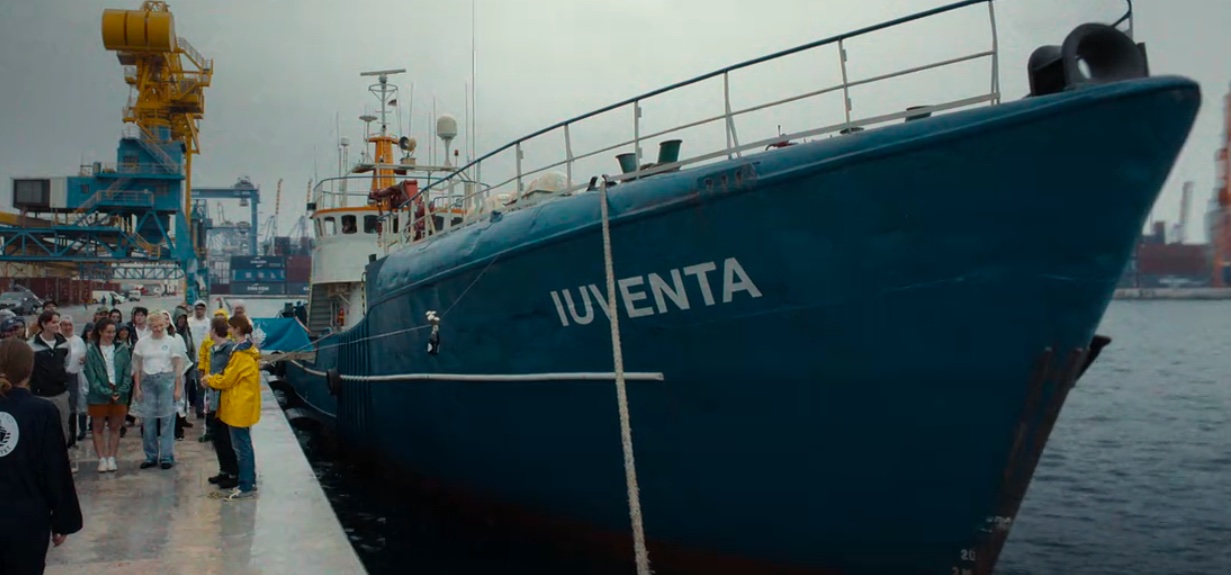
In Netflix’s ‘23,000 Lives,’ a group of young people comes together for a deeply humanitarian cause. It is stoked by the desire to help the people who are fleeing persecution in their country and taking the dangerous journey across the Mediterranean Sea in the hopes of a new life. Since the government doesn’t seem too keen to save those people, most of whom die at sea during the journey, Lukas and his friends decide to do something about it themselves. They form an NGO called Jugend Rettet and launch a crowdfunding campaign to buy a ship to send out to sea to aid rescue efforts. They name the ship Iuventa, which helps them save many lives. The events in the movie, though fictionalized, are based on the true story of Jugend Rettet and the crew who manned the ship that changed lives. SPOILERS AHEAD.
Iuventa was a Real Boat that Saved Thousands of People
In the movie, Lukas and his friends look for old boats to repair and send out to sea to begin their rescue efforts. Something similar happened in real life as well. The people working at Jugend Rettet found a ship named Alk Explorer online that seemed perfect for their mission. The steel motor vessel was built in 1962, measuring 32 meters in length and 7 meters in width. It had a bridge that would serve as the base of operations, where the captain and crew would focus on navigation and mission planning while maintaining radio contact. It also had sufficient space in the cargo hold to serve as a hospital, where they could fit one stretcher and some equipment to treat the people brought on board.
The deck provided ample space to gather the rescued people and to serve as a site for repairs and crew training sessions, while the galley served as the kitchen and dining room. The engine room provided the usual equipment, including generators and a desalination plant, but over the course of many missions, the crew also found it a good place to hide when they encountered hostile forces. The boat’s history revealed that it had been used for all sorts of things over the years, including as a fishing boat and an offshore supply vessel. Given its functionality, it was perfect for use as a rescue boat, and Jugend Rettet eventually bought it for €130,000, thanks to crowdfunding.
They gave the ship a new name: Iuventa. It is Latin for “youth,” likely in the context that almost all volunteers working on it were young people still trying to find their way in the world and hoping to change things for the better. The ship was fixed by the people working at Jugend Rettet and the volunteers who showed up with particular skill sets because they wanted to help a good cause. Once Iuventa was at sea, it served as a first responder, owing to its small size and the Rigid-Hull Inflatable Boats (RHIBs), which allowed it to reach people faster than larger ships. Reportedly, it rescued over 14,000 people, 9,000 of whom were brought on board, over the course of 16 missions during the year it operated.
Iuventa is Too Damaged to be Operational Today
In August 2017, Iuventa was seized at the port of Lampedusa and transferred to Trapani, Sicily, two days later. It is still at the same shipyard. The ship’s seizure was followed by the Italian authorities charging the ship’s crew with accusations of “aggravated facilitation of illegal immigration.” While the case unfolded in the court, the ship was held by the authorities. At first, it was stored in a guarded place, but was later moved to an open area where it no longer had the same protection. According to the law, the one who seized a property was liable for its maintenance during that period, which meant that the responsibility of ensuring the ship’s proper maintenance fell on the port authority of Trapani.
However, Jugend Rettet claims that the authorities failed to do their part, leaving Iuventa exposed and unguarded. Allegedly, the ship was broken into, ransacked, and had some of its equipment stolen. The NGO filed a police report for the same, and their lawyers demanded, in writing, technical inspections and maintenance, but no proper action was reportedly taken, apart from acknowledgment of the concerns. An inspection in October 2022 found that the ship was at risk of sinking, after which a court order in December led to Iuventa being brought to dry dock. The judge ordered its repair and maintenance, directing that it be restored to its condition at the time of its seizure. Jugend Rettet claims that the said repairs never took place.
Iuventa Continues to Serve as a Symbol for Humanitarianism and Solidarity
When the case against the crew was dismissed in 2024, the ship was returned to the NGO, but they found it in such a wrecked state that repairs would have cost more than its current market value. In fact, even moving the ship from its position was impossible, and it remains at the same place where it was docked following the 2022 court order. When the case was closed, the judge found that they were “not competent” to decide who should pay for the ship’s repair. Jugend Rettet was advised to take the matter to the civil courts, so now, they are suing the Italian Ministry of Infrastructure and Transport. They demand proper compensation as well as accountability.
At the same time, the organization sees Iuventa as a symbol of its humanitarian work and of European governments’ attempts to impede its efforts. They wish to memorialize the ship for what it stands for and have invited “interdisciplinary proposals imagining possible futures for the vessel.” They seek to transform it, temporarily or otherwise, into “an artistic, cultural, or participatory space engaging with migration, maritime memory, ecological transition, decolonial imaginaries, and collective care in the Mediterranean.” A public symposium will be held on October 3-4, 2026, allowing the selected participants to present their visions and help keep Iuventa’s spirit alive.
Read More: 23,000 Lives True Story, Explained

