
 Abhiroop Das
Helmed by Toshiki Hirano and adapted from Keisuke Itagaki’s manga series of the same name, ‘Baki-Dou: The Invincible Samurai’ follows right after its predecessor ‘Baki Hanma: The Father vs. Son Saga’, where Baki and Yujiro fight in the battle of the strongest to alter the flow of causality as a whole. Following his victory, Baki appears to have been affected by a perplexing state of boredom, and he is not alone. Without a new “arc” to guide the story, the entire world appears to be standing still, and this prompts Tokugawa to dig into the past and churn out a new future out of it. When Miyamoto Musashi, a legendary swordsman of the Edo period, is brought back to life, all martial artists, Baki included, are given a chance to reassess where they stand in the grand hierarchy of powerful beings. SPOILERS AHEAD.
Baki-Dou: The Invincible Samurai Plot Recap
Following the legendary father-son fight, the world has descended into a state of perpetual boredom. All fighters, seemingly convinced that nothing can surpass what they have witnessed, instead turn their focus inwards. Doppo heads to the mountains while Motobe locks himself in ancient temples to train. But for Baki, the newly crowned strongest man in the world, none of this seems enough. All he can do in the face of every new opponent is stifle a yawn. Sensing this slow degradation of the world, Tokugawa realizes that the path to shaking things up must come from the past rather than the present. Enter Professor Andy, who specializes in extracting live tissue from dead remains. Tokugawa tasks him with doing the same for none other than Miyamoto Musashi, the legendary samurai who lived hundreds of years ago.
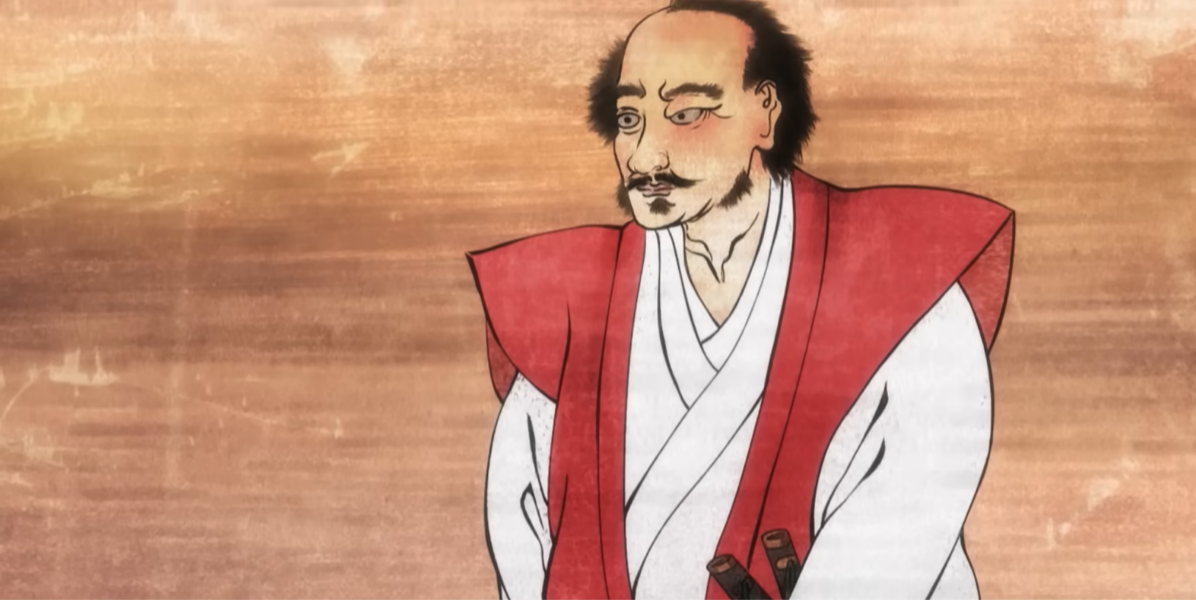
For Tokugawa, locating the remaining life in Musashi is not just an intellectual exercise. His grand goal is to clone Musashi and bring him into this world as a new beacon of strength. As fate would have it, the cloning experiment is a success, and with Sabuko, an old psychic, pouring the real Musashi’s soul into this new body, the resurrection is complete. Having regained his consciousness in an entirely new world, Musashi struggles to make sense of the asphalt, the shinkansen, and the television, but the one thing he feels confident about is his absolute supremacy in the martial arts. One after another, he takes on the modern-day masters of swords and other weapons, and proves himself to be a near-godlike warrior, capable of virtually cutting and cleaving people with his mind alone.
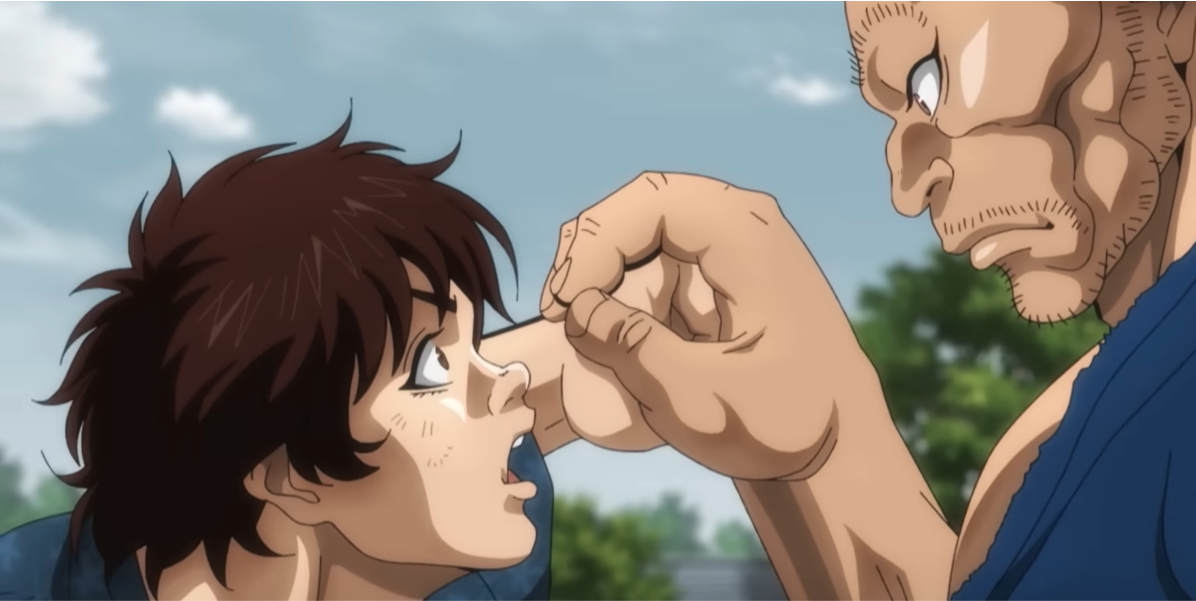
After beating Sabu, the current sword master, Musashi comes face to face with Baki, the boy wonder himself. While the fight initially seems one-sided, with Musashi swinging Baki like a tool, the latter proves himself to be a formidable force, and their unofficial bout ends in a sort of a draw. From there, Musashi’s next opponent is none other than Doppo, who is only momentarily capable of landing a strike on the samurai’s face before he is knocked unconscious. When it comes to Retsu, however, the story’s intensity goes up a notch, as he demands a professional fight in the underground arena, with Musashi using a real sword. Accordingly, Retsu too comes prepared with an arsenal of his own, but is ultimately cut down and dies. This marks a turning point in the narrative, as Motobe realizes that the beast that is Musashi must be stopped before it’s too late.
Baki-Dou The Invincible Samurai Ending: Is Pickle Coming Back? Will He Fight Musashi?
‘Baki-Dou’ ends with the promise of Pickle returning to the underground arena, this time to battle with Japan’s most legendary swordsman, Miyamoto Musashi himself. With the samurai cutting through the ranks and beating Doppo, Retsu, and several others, the story naturally demands an escalation in its display of strength and brutality, which is where Pickle comes in. While he may not be a seasoned martial artist like his peers, Pickle beats just about everyone when it comes to sheer might, and his fight with Jack is a testament to it. Notably, it is never Tokugawa’s intention to have Pickle fight anyone, much less Musashi, anymore. This showdown, instead, is being manifested by Musashi’s hedonistic will, which still perceives this world with a kill-or-be-killed approach.
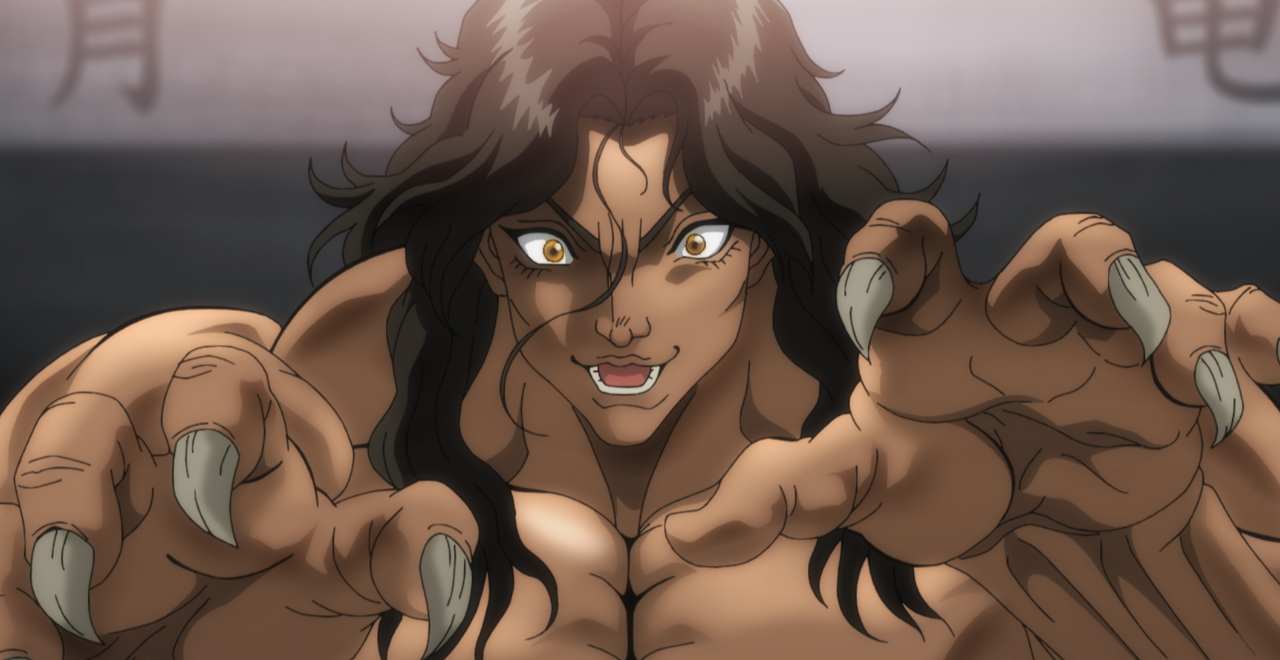
The parallels between Pickle and Musashi are evident in how both are forced into the modern world against their will. However, it is important to note that Pickle’s body was naturally preserved inside a rock, whereas Musashi was deliberately cloned and brought back to life by Tokugawa and his scientists. In essence, the former is closer to nature both in spirit and form, whereas Musashi continues to be a human-made calamity, filled to the brim with internal contradictions. The samurai’s conversation with Yujiro introduces the notion of purity in being, and while so far Musashi has shrugged this idea off, given his lifestyle, a character like Pickle can easily become the impetus he needs.
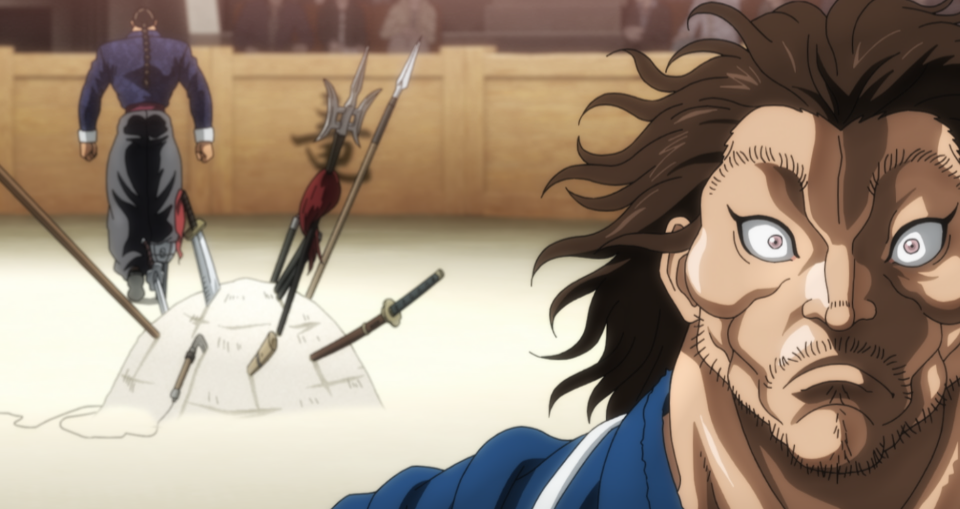
While Pickle and Musashi’s fight of strength vs technique seems like a match made in heaven, it is most likely to take a dark turn as well. Within the world of ‘Baki,’ Musashi’s unstoppable hunger for strength and prosperity has already led to the death of some major characters. With neither him nor Pickle potentially willing to back down, the fight can easily turn into a bloodbath. Moreover, this is also a battle of creative visualizations: for Pickle, fights are only ever a means to consuming what he considers his prey. With Musashi’s motif of a hearty meal finally finding its match in the form of the prehistoric man, the stage is set for a battle more intense than any other in this arc thus far.
Who Wins the Fight Between Musashi and Yujiro?
Although Pickle and Musashi’s fight is slated to take place sooner rather than later, the season finds its actual climax in the clash between the strongest, that is, Yujiro and Musashi. Even before the fight, their brief but layered conversation offers insight into who Musashi truly is, in all his shades. While so far every major character has interpreted his presence as akin to a calamity, for Musashi, all challengers represent the same: a pile of riches and luxuries waiting to be devoured. When looking at Yujiro, he sees a pile that reaches into the heavens, but, unsurprisingly, Yujiro, in return, sees him for who he is, a person of flesh and bone. This discrepancy is also why Musashi’s imitation cut fails to hurt Yujiro, as the latter is firmly grounded in his own reality and can see through illusions.
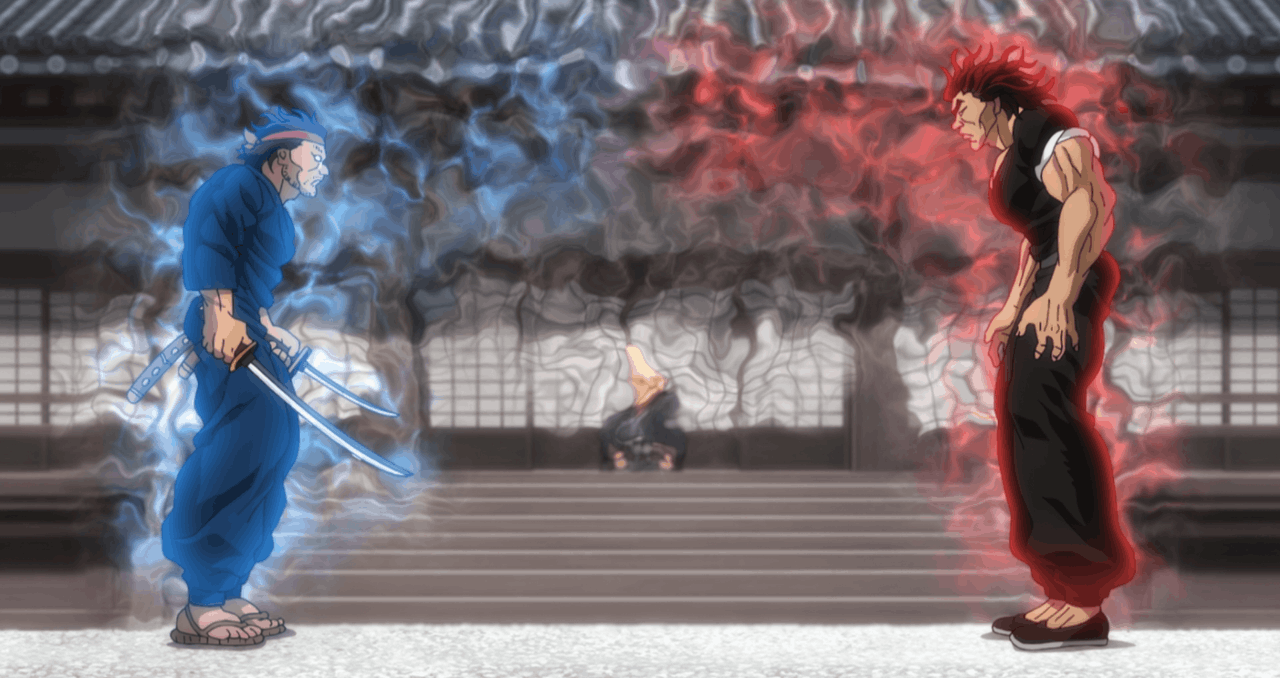
In response to Musashi’s virtual attack, Yujiro educates him on reality by launching a glass shard into his forehead, specifically where the third eye symbolically lies. In a way, this is a direct response to Musashi’s perceived enlightenment, a result of his unquestioned ways of living that he has internalized as a value system. The attack on Musashi’s ego is what starts the fight, and from there, we see even more of Musashi’s characteristics force their way into the open, almost as if in response to Yujiro’s deity-like presence in the narrative. While the swordsman is no match for Yujiro physically, he still refuses to let go of his sword, even when knocked out. With the katana being his only connection to his own time and reality, Musashi embodies his refusal to change, even when it sweeps Yujiro up alongside him.
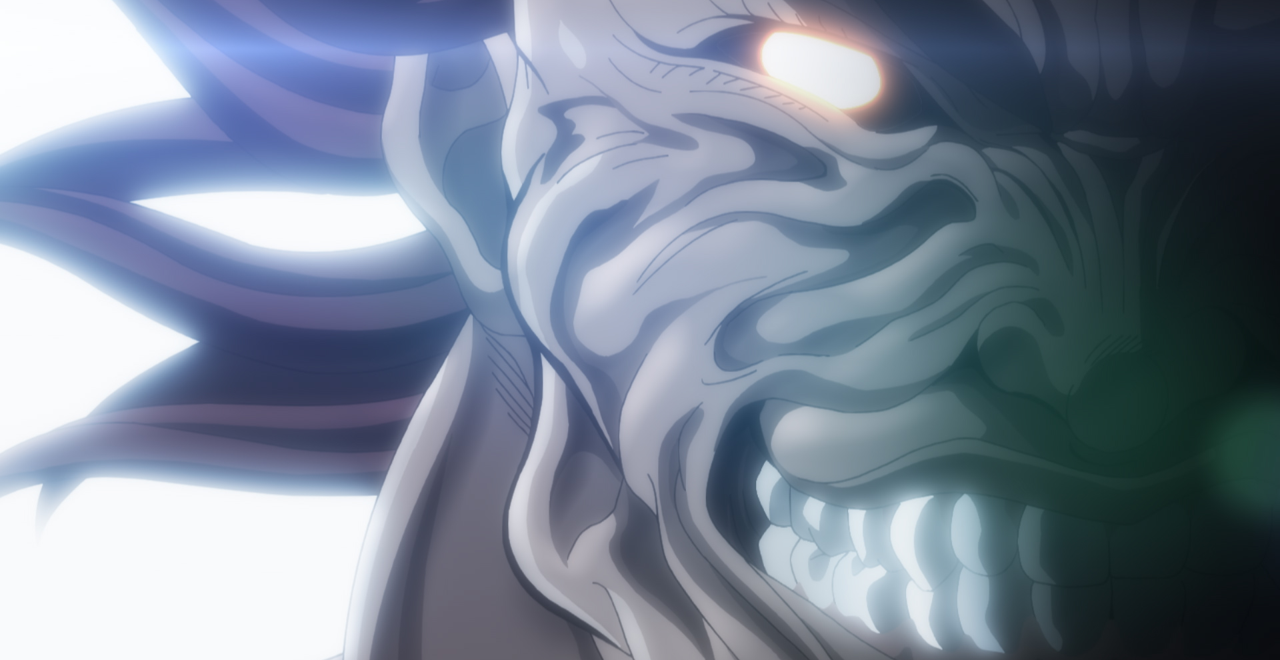
Musashi and Yujiro’s grand fight may have been declared void due to Motobe’s interruption, but a thematic reading of the fight clearly leads to Yujiro as the victor. Not only is he the purest entity in Baki, but also the one who defines the very concept of strength, even retroactively. Thus, the entire fight serves more as a lesson for Musashi, telling him that his old ways of battle no longer hold their own weight. Instead, he undergoes a metamorphosis into a kind of battle hitherto unseen in the story, in which visualization has a real, physical effect. By turning the entire world into his canvas, Musashi realizes that he no longer needs swords to attack the enemy. In essence, this reality-warping ability puts him closer to Yujiro than perhaps even Baki has been, but Motobe’s disruption means that it will be a while before we see Musashi evolve any further.
How Does Motobe Defeat Jack? Why Does He Want to Fight Musashi?
In the final episode of ‘Baki-Dou,’ Jack and Motobe compete for the right to battle Musashi, with Motobe ultimately winning the bout. While the battle between these two underground fighters may have been narratively overshadowed by Yujiro vs. Musashi earlier, there are clear tie-ins between the two events. Specifically, it shows how the presence of two titans has forced the world to evolve in mysterious ways, and both Jack and Motobe represent two strands of progress. As Yujiro’s son, Jack has always defined strength with a single reference point, meaning his fighting style will always involve only his own body, even when it is augmented from top to bottom. Motobe, however, doesn’t have to deal with the same set of contradictions, which is why he wins.
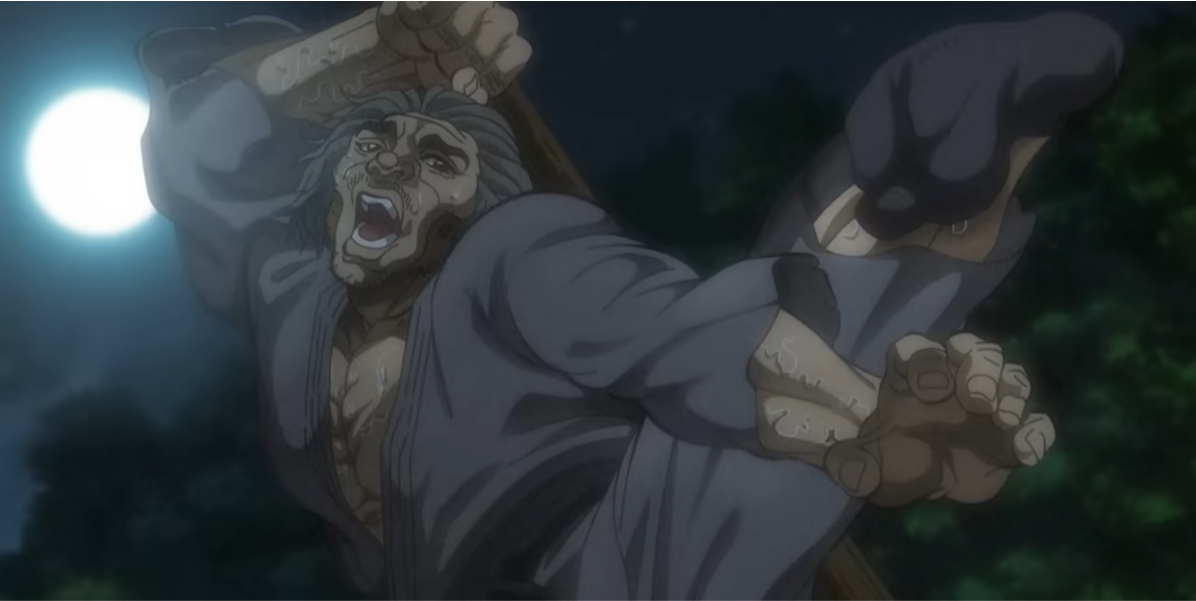
From the very start of the fight, Motobe acknowledges that, while he may be physically outmatched by the likes of Jack and Baki, he is unfettered in how he chooses to fight, with or without weapons. Unlike Jack, who can only acknowledge other means of fighting once they are etched into his own body, Motobe fights like a survivalist, using smoke bombs, ropes, and even guns whenever he needs to. This humble form of martial arts also aligns with his mastery of ancient weapons and styles, which is why he believes he is more deserving of a fight with Musashi. From the get-go, this isn’t likely to be an ordinary bout between the two, as Motobe, a master of the past, believes that Musashi’s modern-day reincarnation is an act of corruption in itself.
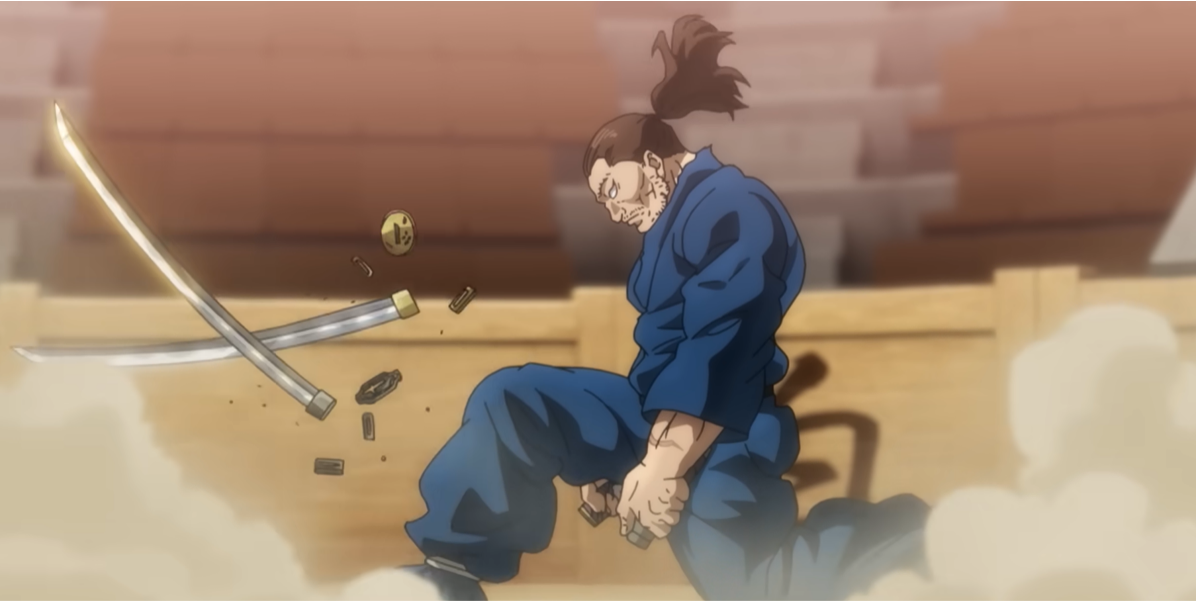
While everyone appears to be fighting Musashi to gauge their own strength, or find the answers they have been searching for all along, only Motobe and Yujiro see Musashi for who he is, a physically, spiritually, and isolated existence whose greatest ongoing battle is with this world itself. Ironically, Jack is closer in psychology to Musashi, as, despite being trained in the classic ways of fighting, his forced acknowledgment of new tech is only harming him rather than helping. This is perhaps best shown in his new, biting-oriented fighting style, which is a direct trauma response to when Pickle ripped his face off. For Motobe, however, these new mechanical teeth prove to be no challenge, as he represents a new form of fighting in a world that has moved past Yujiro’s mold since the legendary battle of father and son.
Read More: The Swedish Connection: True Story of Gösta Engzell, Explained


You must be logged in to post a comment.