
 Abhiroop Das
Co-directed by Carlos Moreno and Claudia Pedraza, Netflix’s ‘Fugue State 1986,’ originally called ‘Estado de fuga 1986,’ reimagines the true story of the Pozzetto massacre that occurred on December 4, 1986, in Bogotá, Colombia, and claimed 29 lives. In this Spanish psychological crime drama series, the perpetrator, Campo Elías Delgado, is fictionalized as Jeremias Salgado, a literature teacher, student, and crossword puzzle maker. However, behind this seemingly ordinary exterior lies a particularly grim past, stemming from his time as a US soldier in the Vietnam War. His darker impulses find an outlet in his friendship with Camilo Leon, a fellow student and literature fanatic. Leon has his inner demons of his own, which often compound and lead him into fugue states. As Jeremias digs his claws deeper into Leon’s psyche, we learn more about his childhood and how it bleeds into his present, inescapable turmoils. SPOILERS AHEAD.
Leon’s Psychosis is a Result of Buried Childhood Trauma
Leon’s fugue states in ‘Fugue State 1986’ are symptomatic of his unresolved psychological scars from when he, as a child, witnessed his father’s torture. While the truth about father’s past is among the show’s most enduring mysteries, the final stretch reveals that Leon was actually on site when his father was abducted and abused. His mother, believing that it was in his best interest to forget the incident, chose to lie about his being at home during the tragedy, and Leon held on to that fact as the truth even as an adult. However, the truth comes to light during his chance encounter with a cemetery troupe that offers spiritual release through music. This ties into Leon’s previous remark of mourning his father while he is still alive. Although he is not at the cemetery for his father, he is called in by the troupe to find closure nonetheless. It is here that he recalls coming face to face with Ocampo, one of the men who tortured his father on that fateful day.
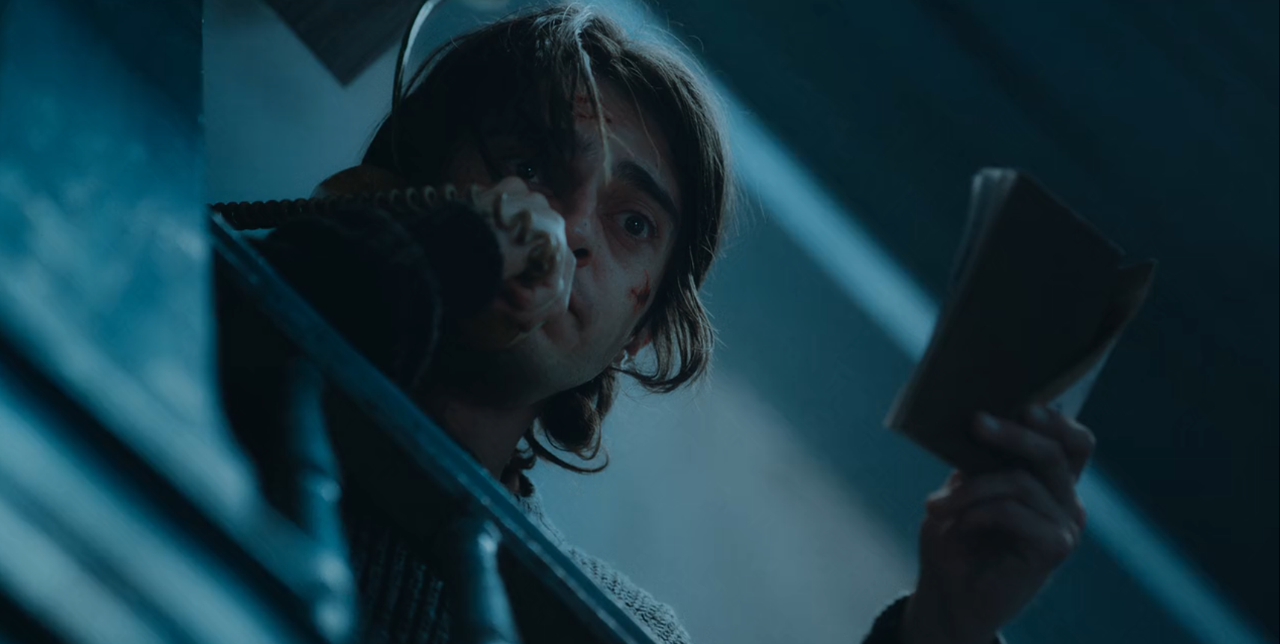
Desperate for answers, Leon, along with Jeremias, went back to the place where he and his father were abducted. From there, he instinctively heads to a nearby cattleshed, where all the memories come flowing down at once. Leon was forced to watch every minute of his father’s torture as a way of adding psychological pressure on both father and son. Although he had managed to bury these traumatic memories deep in his psyche, Leon found them manifesting in other ways. Thus, his fugue state effectively brings him back to the loss of control he felt in that moment, allowing his body to move on autopilot as a way of avoiding his harsh reality. The connection between past and present becomes very literal when Ocampo’s daughter, Teresa, is abducted around the time of Leon’s fugue state, as it is possible that his subconscious desire for revenge is actualized in the most harrowing manner possible. However, that doesn’t turn out to be the case.

During the fugue state, Leon does get a gun from his Jeremias, seemingly to enact his kidnapping plan the next day. However, realizing that he still needs the latter’s help in all of this, he sets up a lunch meeting at San Marzino restaurant, unintentionally involving himself in the massacre. It is possible that his depersonalized decisions are based on minor details from his time with Jeremias, such as the sight of a gun and the restaurant floor map, which foreshadow the tragedy that is soon to follow. However, the moment he sees himself in the mirror, reality sets back in, and Leon is jolted out of his fugue state. This scene is the exact opposite of Jeremias’s encounter with the mirror later in the story, which serves as the final step in his identity fracture. Instead, Leon gets back his grip on reality just in time, potentially avoiding blood on his hands.
Related


Amnesia Serves as a Coping Mechanism in Leon’s Troubled Life
Alongside depersonalization and unplanned excursions, memory loss is among the most serious effects of a fugue state, and Leon has firsthand experience of the same. Upon fully returning to consciousness the morning after the massacre, Leon realizes that he has zero recollection of the night and day before, which then turns into a series-wide mystery. It is likely that Leon’s amnesiac state is triggered due to Jeremias pointing a gun at his face, which brings back the memories of a similar encounter with Ocampo. By erasing all memories of the day, he essentially unburdens himself of much of the emotional processing, protecting his psyche in a roundabout way. However, the amnesia also has unintended effects, as with no way of confirming his activity, he cannot rule himself out as a suspect in both the massacre and Teresa’s kidnapping. Fittingly, it is later his memory of the first conversation with Teresa that helps him locate the real culprit, the school gardener.

In the final moments of the show, yet another layer is added to Leon’s fugue state, this time in a meta-authorial fashion. While trying to rewrite Jeremias’s past in his mind, Leon keeps coming to the cold, unchangeable conclusion, which signals his powerlessness in the face of the human potential for malice. Thus, defeated, he brands Jeremias’s life as a tale humanity is not ready for. This idea perfectly explains Leon’s amnesia as a way of turning a blind eye to who Jeremias really is and what he is capable of. In the same vein, it allows Leon to relinquish accountability and fully lean into his darker impulses. While he manages to save his consciousness in the nick of time, Jeremias’s fate serves as a grim reminder of sorts, explaining Leon’s instinctive desire to shield himself from reality in its most challenging moments.


You must be logged in to post a comment.