
 Diksha Sundriyal
Enola Holmes returns for another curious case in Netflix’s ‘Enola Holmes 3.’ Her third outing holds more personal stakes as her brother Sherlock is kidnapped, and she has to race against time to find him. In the quest for answers, she finds two clues that hold the key to getting to the bottom of the mystery. “Khost” and “Wrath” seem to be connected to the case, and as Enola starts to unravel their meaning, she discovers that the scale of things is much bigger than she’d imagined. By the end, some mysteries are answered, while the others linger in the shadows, leaving a trail of crumbs that may lead to a future case. SPOILERS AHEAD.
Khost Leads Enola to a Hidden Treasure
After Dr. Watson tells Enola that Sherlock has been kidnapped, her first act is to go to the crime scene. She visits her brother’s room in Hotel Cornelisse, looking for the signs that may have been left behind. A quick look at the room reveals that the kidnappers were not interested in finding anything in Sherlock’s possession. They wanted him, but before they dragged him away, he managed to leave a message for his sister, who he knew would come looking for him. Enola finds a message in Morse code on the mirror in Sherlock’s room that reads “Khost.” The only Khost that she and Dr. Watson know of is the place in Afghanistan, but they have no idea how it may relate to Sherlock. It isn’t until she looks at the medals of Tewkesbury’s father that the hint of an answer starts to emerge.
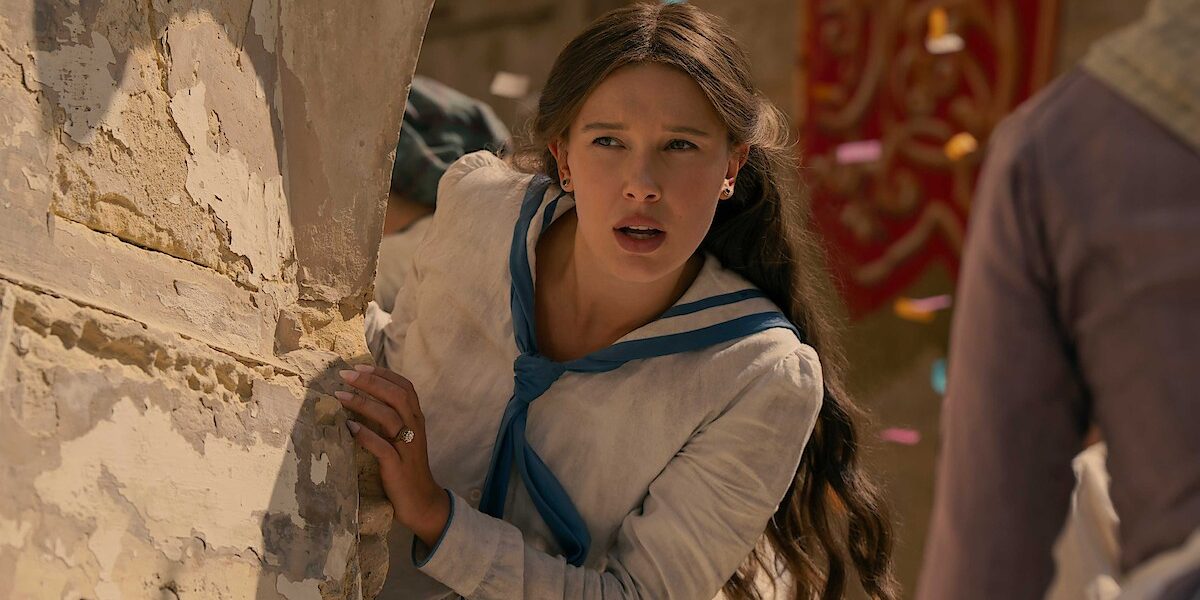
It turns out that the late Lord Tewkesbury served in the British army and fought in the Anglo-Afghan War. The battle took place in Khost, which explains why the word was left behind by Sherlock. To understand why the Afghan city is important in this context, they take a look at the military records. It turns out that fighting the Crown’s war had started to take a financial toll on the army. They needed more financial backing to keep going, but the coffers were already low due to the conflicts the country was involved in. To keep the soldiers alive and fighting, the army needed some backing. When their government couldn’t provide the money, they were told to find it themselves. Lord Tewkesbury was at the helm of the army fighting in Afghanistan, and he concluded that the only way they could have resources to keep going now would be by looting the locals.
He wasn’t entirely happy about this morally questionable act, but he believed that he had no other choice. So, the looting and pillaging happened, and the army found a trove of gold. They were supposed to bring it back to the Crown, but midway through the journey, Lord Tewkesbury’s conscience won, and he decided not to give the gold to the Crown. The plan was to get the treasure to Malta, and it would be claimed that it was found there. But before they reached Malta, Tewkesbury revealed his intentions. When the others didn’t agree, he sank the ship and hid the gold somewhere no one could find. Eventually, this gold turns out to be the reason behind all the murders and kidnappings, which is why the clue is left for Enola so she knows what to look for.
The Mystery of Wrath Sets Up Enola Holmes 4
Before Enola fully understands the meaning of “Khost,” she is given another word as a clue. Shortly after her failed wedding, she notices a soldier walking around. She remembers him as the man that Sherlock had sought out during the pre-wedding dinner. Believing that he may know what her brother was involved in, Enola chases after him. When she does catch up with him, it is too late. He is shot by an unseen person, and in his dying breaths, he mutters the word “wrath.” At first, Enola cannot make sense of it, but then she hears the name “Adeline Rathe.” She realizes that she may have misconstrued the soldier’s words. Perhaps, he was saying “Rathe” and not “wrath.” The woman turns out to be a complete mystery; the only thing Enola learns about her is that she is very powerful and has friends in high places.
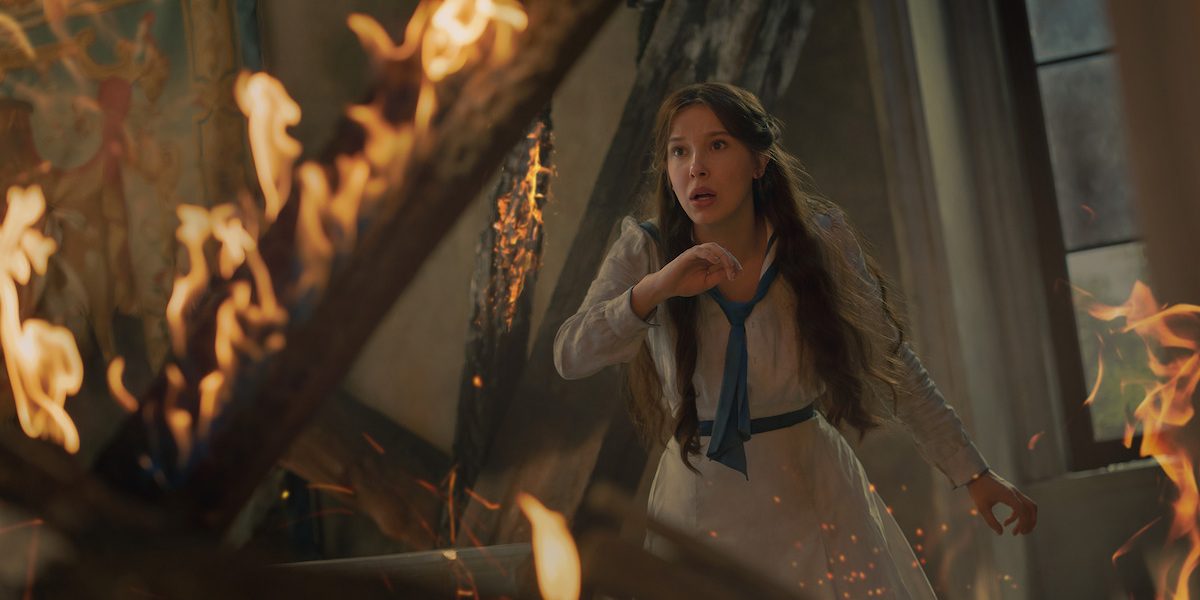
Later, Enola finds a woman believed to be Adeline Rathe, but she turns out to be Moriarty’s spy, who kills her to shut her up before she can tell Enola more. This seems to be the end of that line of investigation, and Enola doesn’t think twice about it because the whole picture eventually becomes clear once Moriarty’s involvement is noted. Sherlock is saved, the gold is found, and she and Tewkesbury get a happy ending. In the last scene, though, the camera pans into the depths of the ocean, taking the audience to the wreckage of a ship, likely the same one the late Lord Tewkesbury brought the gold on and then sank. Interestingly, the ship is named “The Wrath of Adeline,” which means Enola had not been wrong. The word was “wrath” after all; it just didn’t point towards a woman, but a ship.
This indicates that Enola hasn’t fully cracked the mystery of what really happened to Tewkesbury’s father and his ship. Perhaps the reason it sank wasn’t the gold but something else. It also remains to be seen what the dying soldier was really talking about when he whispered that word to Enola with his dying breaths. Whatever it may be will be revealed in what will certainly turn out to be the young detective’s next adventure. With her being married to Tewkesbury, the mystery will once again be closer to home, and it will be easier for her to dig for answers because there is a good chance that all the clues to the mystery are already in front of her.
Read More: Where Was Enola Holmes 3 Filmed?


You must be logged in to post a comment.