
 Abhiroop Das
Created by Jonathan Glatzer, AMC’s ‘The Audacity’ tracks the life of Duncan Park, a tech CEO whose Silicon Valley company is on the verge of sinking. Though he manages the stock prices at a record high, things behind the scenes devolve faster than he expected, threatening his entire legacy. To escape all of this, he reaches out to the valley’s most popular psychologist, Joanne Felder, who is not without her share of skeletons in the closet. What this leads to is a rather unorthodox doctor-patient arrangement, where every episode pulls Duncan and his company, Hypergnosis, into the direction of pure chaos. However, Hypergnosis is merely one company in a much larger tech ecosystem, and Duncan soon has to learn the hard way that he is not the only one hungry for more.
Hypergnosis is a Fictional Data-Mining Company Nestled at the Heart of Silicon Valley
Hypergnosis is a fictional company created by Jonathan Glatzer and his writing team specifically for ‘The Audacity.’ Described as a data-mining company with a sky-high stock evaluation, Hypergnosis provides the backbone for the show’s satirical take on Silicon Valley. In a conversation with Entertainment Weekly, Glatzer confirmed that most in-narrative elements, including the company, aren’t directly based on real-life. In that vein, he called the setting “reality adjacent,” adding that there is no Google in this world, and most of the companies we see are either made entirely from scratch, or are look-alikes or sound-alikes of real equivalents. Hypergnosis appears to belong to the former camp, and it makes sense given how important it is to the show’s main storyline.
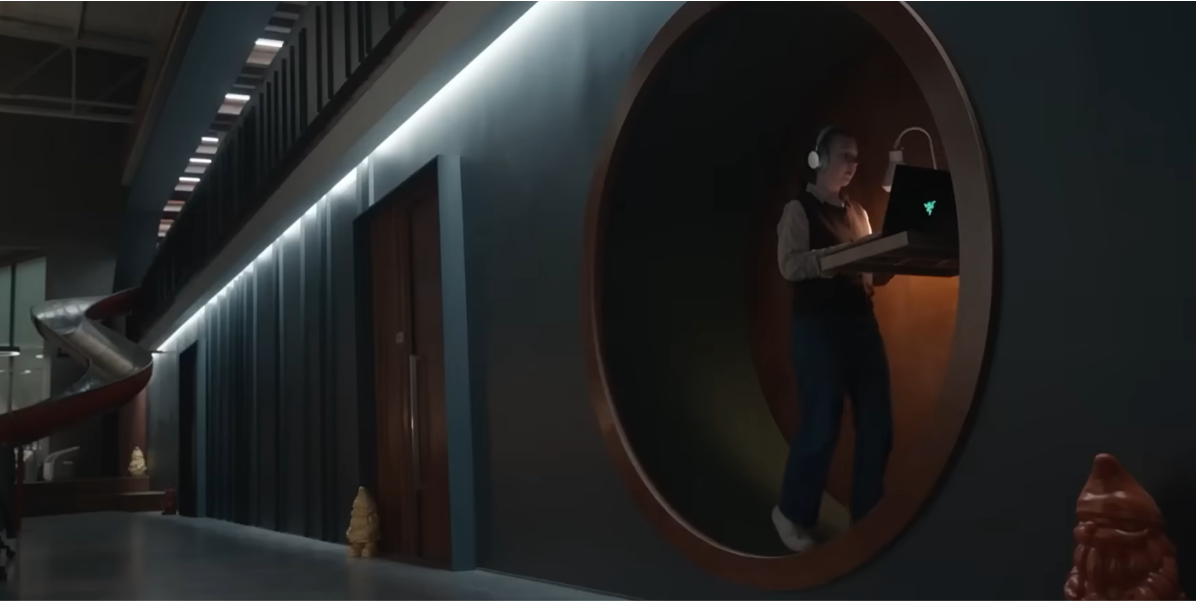
For Glatzer and his team, creating fictional companies allowed for free experimentation and commentary in a manner that could not be replicated with real namedrops. With a show specifically about the boundaries of privacy and ethics in technology, opting for an invented data-mining company made the most sense. Glatzer’s perspective on the tech world also fits into this, as he is far more interested in the interiorities of the community. During the interview, he explained that his characters and companies operate in a bubble, which comprises a “fairly distorted view of self, of wealth, of the world, of how to change the world.” And nowhere in the narrative do we see this thought evolve more than in Duncan Park’s arc.
Duncan Park is a Fictional CEO Who Yearns to Sit at the Top of the Food Chain
Duncan Park, the CEO of Hypergnosis and a self-proclaimed “inventor of the future,” is a fictional character conceived by Glatzer and his crew to lead the show. In many ways, Duncan embodies what Glatzer finds most interesting about Silicon Valley: desperation. In his interview, he compared Duncan to people who have “more than enough — way more than most of us have— and yet they have not succeeded in Silicon Valley terms, where even a billionaire is not that unusual there.” Actor Billy Magnussen referred to the character as the culmination of his entire career thus far, which is backed up by his co-star, Paul Adelstein, who called it the role Magnussen “was born to play.”

Though Magnussen humorously followed up Adelstein’s compliment with “The narcissistic man-child, that’s the perfect role?”, he is deeply in tune with who Duncan is, in all of his highs and lows. More than a wannabe tech titan, he considers Duncan to be a man who starts out with a genuine wish to improve the world. Such a character, Magnussen mused during the interview, “was probably not the popular kid in school.” For the actor, it is the participation in a rat race of sorts that corrupts Duncan’s way of living over time. The actor explained, “All the audacious things he (Duncan) does, in his head, he’s doing it for the right reason. I don’t think he intentionally wants to hurt anyone.” All of this serves to further humanize his character, which has been the show’s goal to begin with.
Glatzer called Magnussen’s approach to the character a blend between certainty and insecurity, which is precisely the vibe Duncan gives off in the show with his never-quit attitude, even when the entire world seems to be collapsing in on itself. While it is possible that Magnussen researched real-life tech CEOs to nail the archetypes of such mannerisms and thought processes, most of what we see on screen is an original creation by him and the writers of the show.
Read More: Is Netflix’s Thrash Based on a True Story? Are Hurricane Sharks Real?


You must be logged in to post a comment.