
 Aahana Swrup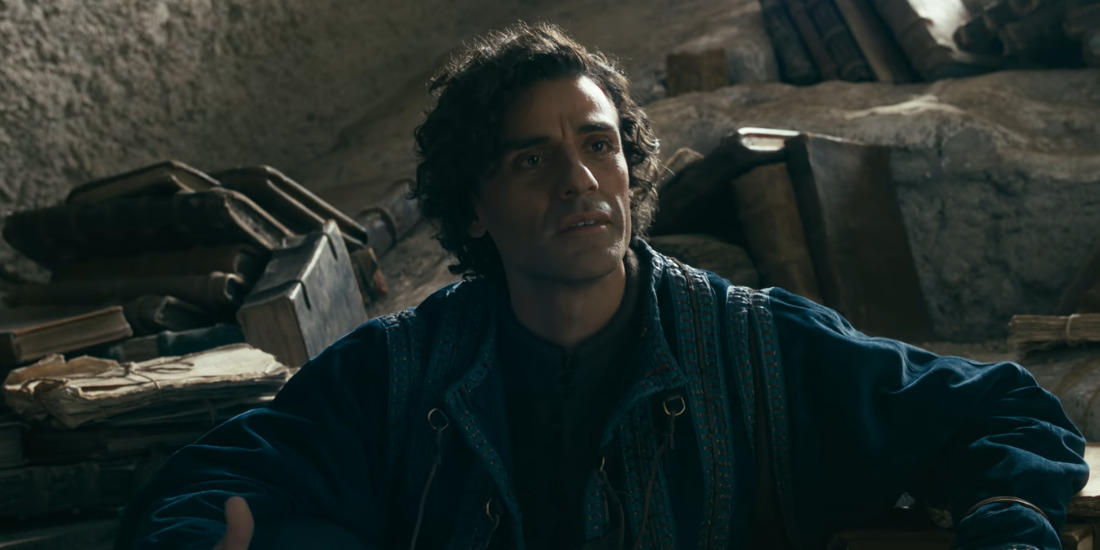
‘In the Hand of Dante’ splits its narrative between two storylines unfolding across two different time periods. The story that develops in the 21st century finds Nick, a writer and a passionate enthusiast of the artistic works of Dante Alighieri, an Italian poet from the 1300s. The latter artist becomes the center of the secondary Technicolor timeline, which progresses in tandem with Nick’s black and white landscape. Dante’s story revolves around his excommunication from the Church and his exile from Florence. In the aftermath of these life-altering events, he embarks on an adventure to find the inspiration for his next poem, ‘Divine Comedy.’ On multiple occasions, the poet’s character speaks in his native tongue, Italian. Consequently, the nature of actor Oscar Isaac’s grasp on the language remains worth exploring.
Oscar Isaac Likely Studied Italian For His Performance as Dante
In ‘In the Hand of Dante,’ Oscar Isaac portrays a dual role of Nick and Dante, the two protagonists of the story, suspended in different time periods. While the former is a writer from New York traversing through the early 2000s, the latter is an Italian poet from the 14th century. Despite sharing a face and several thematic similarities, the two characters remain distinct from each other. One of the elements that underlines these distinctions is Dante’s frequent usage of Italian as well as the English language.
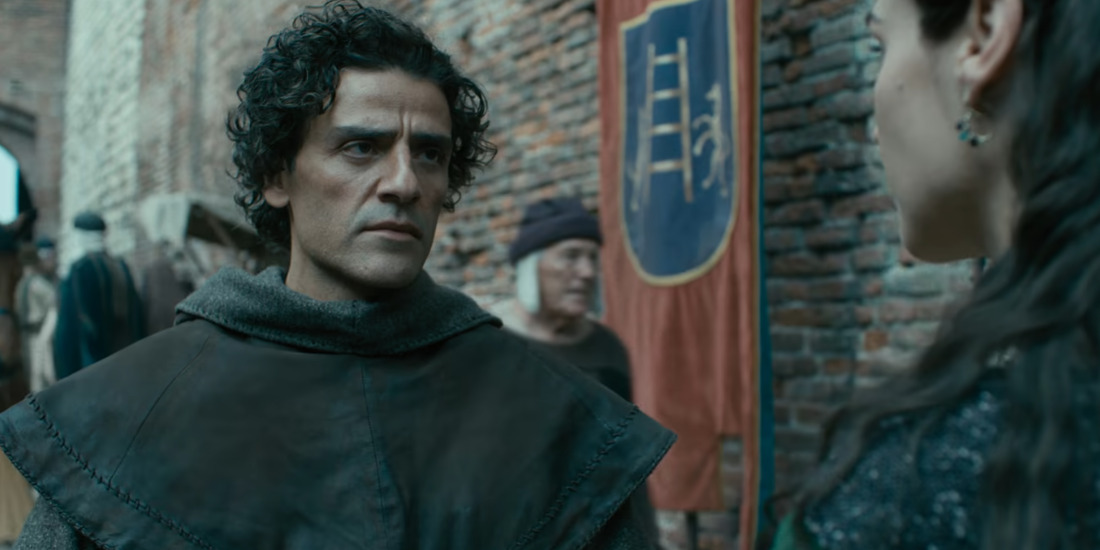
Thus, in the film, Isaac delivers multiple strings of dialogue and even a monologue or two entirely spoken in Italian. Although he is bilingual, mastering both the English and Spanish languages, as far as one can tell, his linguistic prowess does not extend to fluent Italian. As such, it’s most likely that the actor studied the language for the role in order to deliver an authentic and powerful performance. In a conversation with Soundsphere, Isaac spoke about the preparations he made for the roles of Dante and Nick. This included a close study of the 2002 novel written by Nick Tosches, which serves as the source material for the film. Additionally, he also engaged with Dante Alighieri’s original work in English as well as the original language it was written in.
In the interview, Isaac shared, “(For me,) There was almost something every night that I would come home, almost something Talmudic about the way that I would prepare at night. I would have Nick Tosches book and Nick’s poetry recordings of him and the Divine Comedy, three different translations in English, and then the original Italian. Depending on what we were shooting the next day, derive and divine from these texts to see what would be possible the next day, what maybe we could add in, what we could replace, what could just be there to be able to trust the one or two takes that we would be able to get before the light went, before we had to move on to the next place.” Thus, it seems the actor put in the work required to bring Dante’s character to life, ensuring to maintain moments of authenticity by committing to the poet’s native tongue.


You must be logged in to post a comment.