
 Abhiroop Das
Written and directed by Thérèse Ahlbeck and Marcus Olsson, Netflix’s ‘The Swedish Connection,’ or ‘Den svenska länken,’ steps behind the scenes in World War II, specifically focusing on the inner workings of the Swedish government at that time. Given their stance of neutrality, government officials have to be exceptionally wary of Nazi Germany, which often means a restriction on the emigration of Jewish people. However, when Gösta Engzell, a bureaucrat working in the Foreign Ministry’s legal department, hears of the ongoing Holocaust, he decides to take a stand, even if it means tweaking the law along the way.
Thus begins a complex back-and-forth between Engzell and various powerful forces, with his end goal being the rescue of thousands of Jewish people who are fighting for their lives every day. His primary roadblock in this journey, however, turns out to be Staffan Söderström, his superior in the industry, and a man who wants to maintain the status quo, however possible. As the Swedish historical drama movie progresses, Engzell and Söderström enter an elaborate game of chess, one that promises to alter the fate of Sweden as a whole.
Söderström is Based on Staffan Söderblom Who Oversaw Swedish-German Relations During World War II
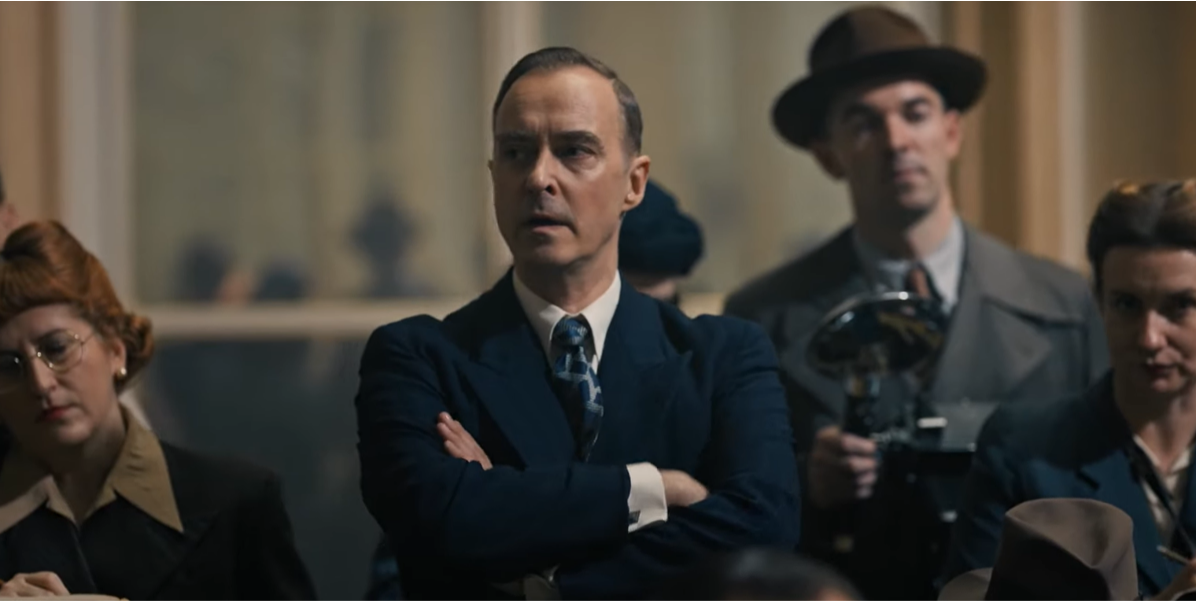
Staffan Söderström in ‘The Swedish Connection’ is a fictionalized version of Staffan Söderblom, who was known for heading the Swedish Foreign Ministry’s political department during the peak of World War II. While Söderström in the film may be directly inspired by Söderblom in real life, the differences in names suggest that writers Thérèse Ahlbeck and Marcus Olsson took a number of creative liberties while developing the character. Born on July 14, 1900, Söderblom was a prodigy and graduated from high school at the age of 15. As a polyglot, he had reportedly mastered as many as seven languages by the time he joined the Ministry for Foreign Affairs. Over the years, he went on to become the secretary of the Swedish delegation to the League of Nations, and then, in 1938, he became the head of the ministry’s political department, as well as its foreign affairs counselor.

While various records mention that Söderblom was preoccupied with the balance between Sweden and Nazi Germany, it appears that much of Söderström’s role in the film is an invention of the writers’ team. There are no existing records that point to any discord between Söderblom and Gösta Engzell in real life. However, the fact that Engzell brought the rise in asylum requests from Jewish people appears to be taken from real life. As per what Söderblom told Aftonbladet in 1979, Germany at that time (1942) was an almighty power, and it would have been significantly risky to oppose their regime’s actions. However, as we know, Engzell and his team managed to find their own way to bring in Norwegian and Danish citizens to Sweden, in a move that directly impacted thousands of lives.
Söderström’s Characterization in the Movie is a Blend of Fact and Fiction
Söderström’s framing in the movie as an antagonist who actively opposes Engzell’s initiatives appears to be a heavily dramatized account of history, with only a superficial connection to real life. However, one element introduced in the story that does align with reality is Söderström’s appointment as a Swedish envoy to Moscow, in the former USSR. In real life, Söderblom too was sent to Moscow as an envoy from 1944 to 1946, and during this period, he was criticized for his response to the disappearance of Raoul Wallenberg, a Swedish diplomat and humanitarian who was allegedly arrested by Soviet forces.
Notably, Wallenberg is the narrator in ‘The Swedish Connection,’ and while he makes a brief appearance towards the end of the movie, he never interacts with Söderström, further pointing to the crafted nature of the latter’s character. After his time in Moscow, Söderblom was appointed as an envoy to Bern, Switzerland, and later went on to become ambassador to Beijing in 1951. He died on December 11, 1985, at the age of 85. While Söderblom was an influential figure in real life, the film’s take through his fictionalized version presents that element in a vastly different light. However, reports make it clear that his approach to foreign policy was centered around the idea of maintaining neutrality above all.
Read More: Is 56 Days a True Story? Are Oliver and Ciara Based on Real People?


You must be logged in to post a comment.