
 Abhiroop Das

Helmed by Padraic McKinley, ‘The Weight’ is a historical drama film set during the Great Depression, when people from all walks of life faced the crisis in their own ways. One such story is that of Murphy, who is separated from his daughter after his arrest and has only a brief window before she is placed in foster care. Barely holding on to hope, he finds his chance to be free when Warden Clancy promises him release on the condition that he assists in the transfer of gold from a gold mine that’s about to be shut down. This, however, is a high-risk assignment, as multiple mines have seen instances of looting. As Murphy commits to the task, he is joined by three other prisoners given a similar assurance as he is. What none of them know, though, is that their journey is fated to derail, and whether any of them can make it out of this alive is a question none of them is prepared for. SPOILERS AHEAD.
The Weight Plot Synopsis
The story begins in 1933, in the middle of the Great Depression in Oregon, where World War I veteran and widower Samuel Murphy is struggling to support his young daughter, Penny. After being evicted and forced to sell Penny’s teddy bear, Murphy ends up fighting plainclothes policemen and is sent to prison, while Penny is placed in a home. Four months in, Murphy is transferred to a labor camp, where he meets Warden Clancy and soon impresses him with his skill. This earns him an invitation to Clancy’s house, and while repairing his car, Murphy expresses his fears of losing custody of his daughter if he isn’t released soon enough. Hearing this, Clancy makes him a peculiar offer about a dangerous assignment that, if completed, will secure his release within a month.
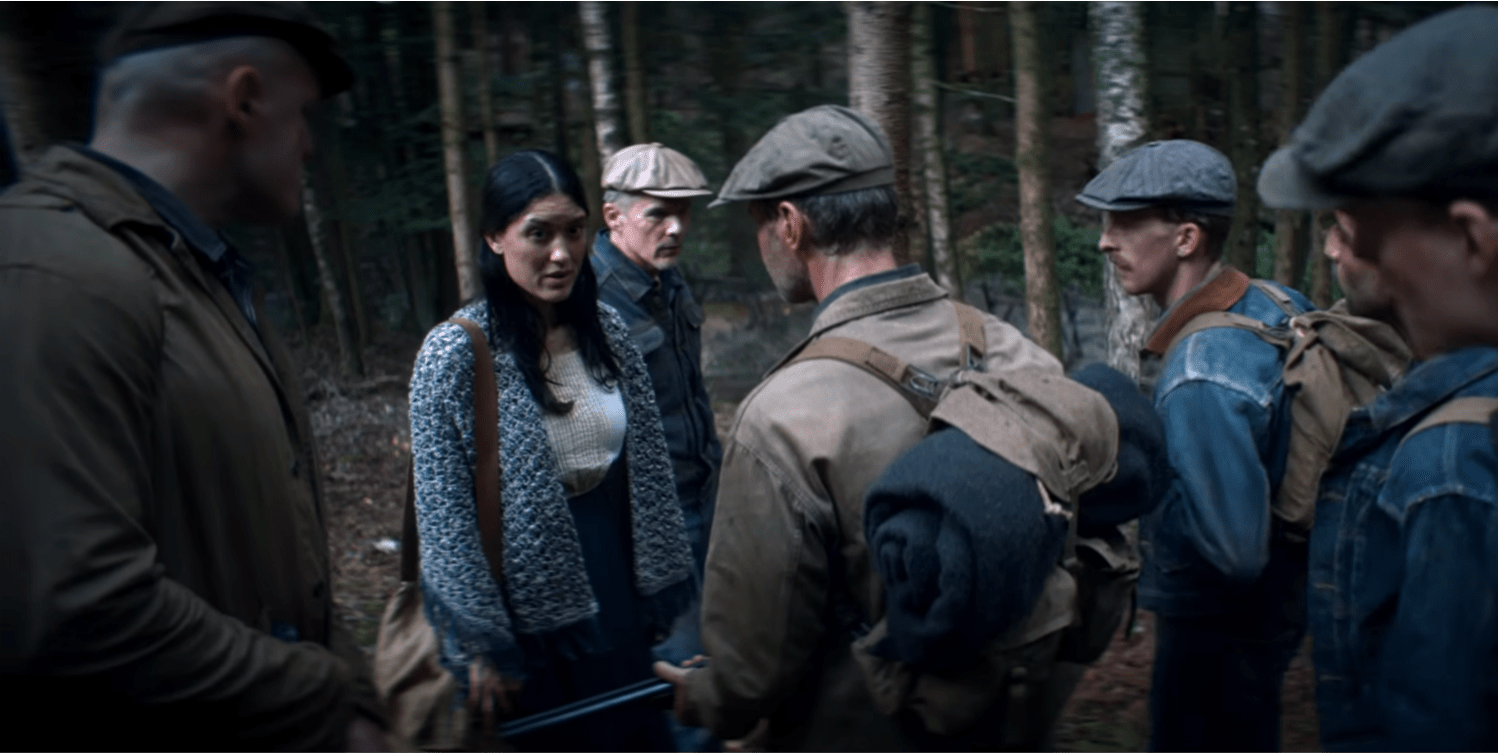
Desperate, Murphy accepts the offer, recruiting his fellow prisoners Singh, Olson, and Rankin. The four men are then sent to Black Hawk Gold Mine Inc. in Klamath Falls, where they meet an operator, Taggert, who explains a plan to take several gold bricks through the wilderness and deliver them across the lake in six days. Escorted by two armed guards, Amis and Letender, the group begins the journey carrying heavy packs of gold, implicitly understanding that they are being used for theft. Before long, they discover that they are being followed by an Indigenous woman named Anna, who was fleeing the mining camp, and eventually joins the group. As the days pile on, the journey becomes increasingly dangerous when they come across a broken bridge and must toss the bricks individually. Not long after, Murphy nearly drowns after getting trapped under a log jam, but is rescued by Anna.
Upon discovering two boats belonging to a group of miners who likely came to steal the gold, Murphy and company decide to take the boats for themselves, but are shot at on their way out. As a bullet tears through Olson’s leg, the situation seems too dire, and as his condition worsens, the two guards decide to murder him in cold blood under the cover of a stormy night. However, Rankin ends up seeing it all and warns the rest of the crew. Later, when Letender tries to assault Anna, Murphy and Rankin fight alongside her, eventually killing him, and later Amis. Though Taggert arrives and tries to run away with the gold, Murphy manages to steal a car and chase Taggert down off the road, presumably killing him. With the gold retrieved, Murphy and the crew arrive at Clancy’s house, determined to put an end to the crisis.
The Weight Ending: Does Murphy Reunite With His Daughter?
‘The Weight’ ends on a happy note for Murphy as he reunites with Penny and takes her on a joyride. Not just that, but he also repurchases her teddy bear that they had to sell off at the start of the film. All of this is made possible by Murphy’s rather unique rags-to-riches story, which involves getting his share of the gold from Clancy. Before bidding the warden goodbye, he makes sure to take the car as well, making himself whole in a sense. The final scene of the film, as such, mirrors the very first one, as Penny and her father ride off into the sunset at max throttle, celebrating how far they have come, and how far they have left that grim life behind.

All the suffering that Murphy has to endure over the course of four odd months is, in some ways, a microcosm of the Great Depression itself. After first being abused by the state into submission for no fault of his own, Murphy is coerced into doing something illegal. All of this happens while the people with real power, such as Clancy, sit in leisure and take the spoils for themselves. While the movie doesn’t confirm it, there is a good chance that Clancy’s plan was to frame Murphy and his team for the theft, and perhaps even have them killed. All along, he never truly respected Murphy for his skills, but rather saw his competence as something that could be exploited for selfish gain. By the end, Murphy simply flips that equation on its head.
It is important to note here that we never actually learn anything about Clancy’s family, leaving good reason to assume that he simply doesn’t have one. This lack of interiority is contrasted by just how fiercely Murphy loves his own daughter, to the point of going through hell and back just in the hopes of an early release. Upon learning that the system itself is against him, however, Murphy revolts, not out of a sense of greed or rage, but simply to be treated with fairness and dignity. While the Great Depression is a period of great sorrow and suffering, Murphy manages to claw his way back towards a better life, in the process learning what it’s like to truly stand up for his rights and put his skills to good use.
Who Gets the Gold? What Happens to Singh and Rankin?
In the end, the gold transported by Murphy and team gets evenly split, with Clancy getting a cut too. While the warden initially intended to take home the lion’s share of the gold, he is thoroughly outsmarted and has no choice but to accept this deal. There is also a strategic reason for this distribution: it makes Clancy equally guilty across the entire operation. While he could, hypothetically, report all the inmates and bring them back to prison, doing so now would risk unveiling his own complicity in the heist. Thus, an elaborate system of checks and balances is put into place, leaving everyone on board, be it Clancy, Murphy, Anna, Singh, or Rankin, significantly richer than before.

The team also doesn’t forget to reserve an equal share for Olson’s family, as he is ultimately as much a part of the team as anyone else, even in death. Olson’s death is the result of both a systemic failure and the cold-heartedness of Amis, and therein lies a karmic effect. With Taggert, Amis, and Letender dead, the heist team has the perfect three people to frame the entire crime on. Clancy likely planned to declare that they were acting on their own and simply escape with all the gold, and, just like that, the case would have been doomed. It is particularly ironic because of how Taggert goes about claiming that his two gunmen are the only ones he can trust with the gold, but now that narrative is flipped for good, at least in public memory.
While we follow Murphy’s conclusion to a satisfactory point, the stories of Singh and Rankin are left rather ambiguous. Just like Murphy, they are now among the richest people in the country, and that can either make or break their future. Knowing Singh, he is likely to restart his socialist endeavors, and perhaps even use that huge sum of money to fund his campaigns. On the other hand, Rankin, who has been in and out of prison since his teens, is likely tasting true freedom for the first time as an adult. While this can take things sideways very easily, his evolution over the course of just these five days is indicative of how prepared he is for this new chapter of life.
Do Murphy and Anna End Up Together?
The final sequence of the film suggests that Anna joins Murphy in Eugene, Oregon, though that doesn’t necessarily mean that they end up together. With nowhere to go, it is natural for Anna to stick with one of the very few people that she can trust, and that doesn’t have to necessitate them having a love story. This detail is quite significant to her arc as well, as at one point she very vocally states that her relationships do not define her. While some, such as Amis and Letender, see her only under the stereotypical framework of a homemaker, Anna proves them wrong by showing herself to be the most competent person in the group. By the end, she too gets a share of the gold and is allowed to lead her life without financial dependence and with dignity.

While the ending neither confirms nor disproves the idea of a budding romance between Anna and Murphy, there are numerous threads in the narrative that do point towards something to that effect. For starters, there is the kiss with which she quite literally breathes life into Murphy during a moment of underwater crisis, following which she helps him take his wedding ring off an injured finger. All of these scenes have a clear symbolic purpose, showcasing both the characters’ subconscious desires to move on from their past and start anew. Before they can end up together, however, the two of them have to heal from their own traumatic pasts and see the road ahead to its end.
Read More: Is The Trap a True Story? Is Lisa Konrad a Real Novelist? Is My Sister Based on a Real Novel?


You must be logged in to post a comment.