
 Abhiroop Das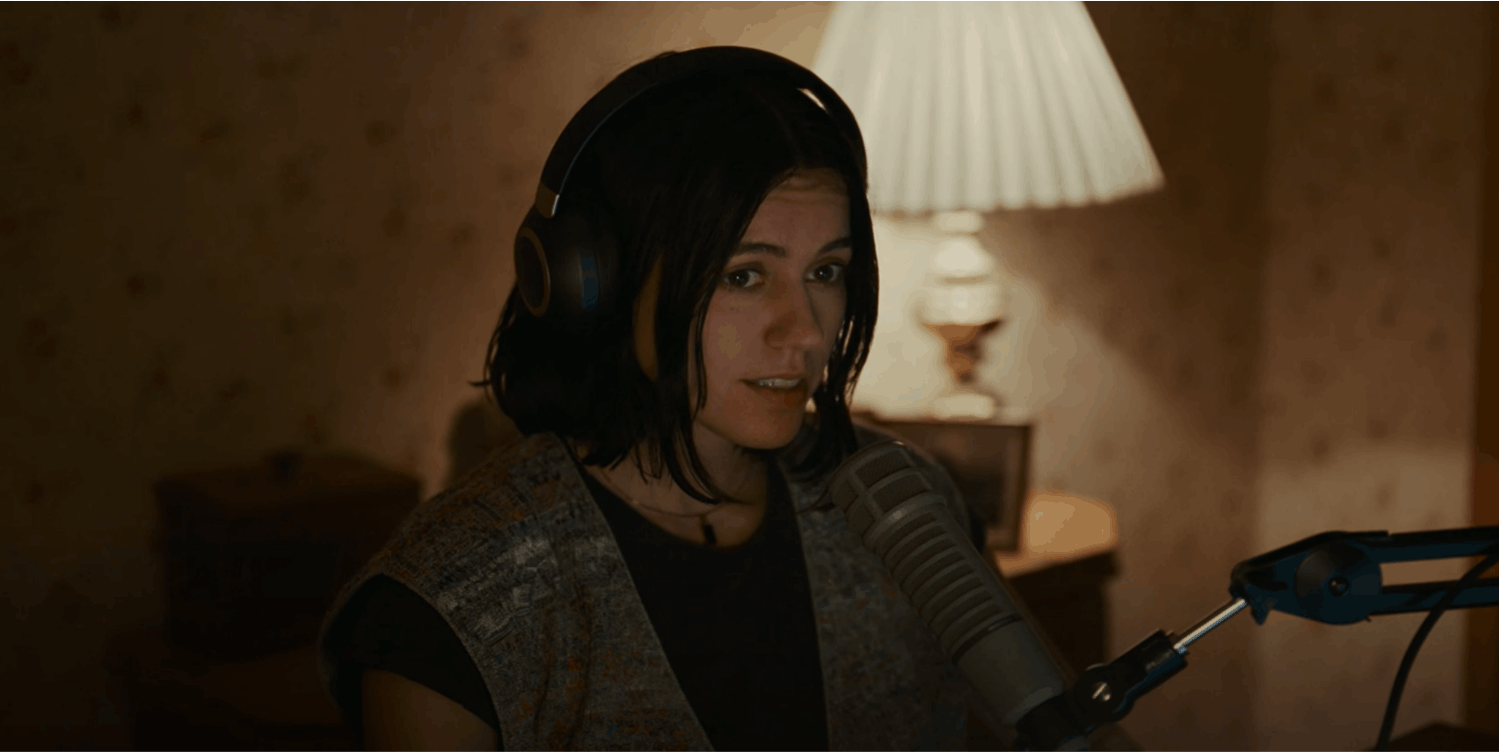
Helmed by Ian Tuason, ‘Undertone’ is a tale that begins with Evangeline “Evy” Babic trying to take care of her dying mother as she juggles her job as a podcaster and a series of dwindling personal relationships. When things seem to go too wrong, she finds momentary respite in putting on her headphones, tuning out the world, and immersing herself in the world of horror. Her podcast, ‘The Undertone,’ which she hosts with her friend Justin, is built on the idea that she is a perpetual skeptic. However, when a series of ominous voice recordings comes her way via an anonymous mail, Evy begins to wonder if the stuff of nightmares can leak out of the screen and manifest in her home. In telling this tale, the horror movie questions the boundaries between the natural, the supernatural, and everything that rests in between.
Undertone is a Fictional Story Inspired by a Significant Chapter in the Director’s Life
‘Undertone’ is a work of horror fiction written by Ian Tuason, which finds its loose inspiration in his lived experiences, specifically from the period when he was providing end-of-life care to his parents. The initial versions of the story were developed during COVID-19, with Tuason envisioning it as a found-footage style radio play. The writer-director found his inspiration in a bunch of his favorite horror films, as well as a YouTube video of someone listening to some songs backward in an effort to unravel new, sinister meanings. However, things took a more personal turn when his parents, Azucena and Ernesto, began a difficult battle with illness.
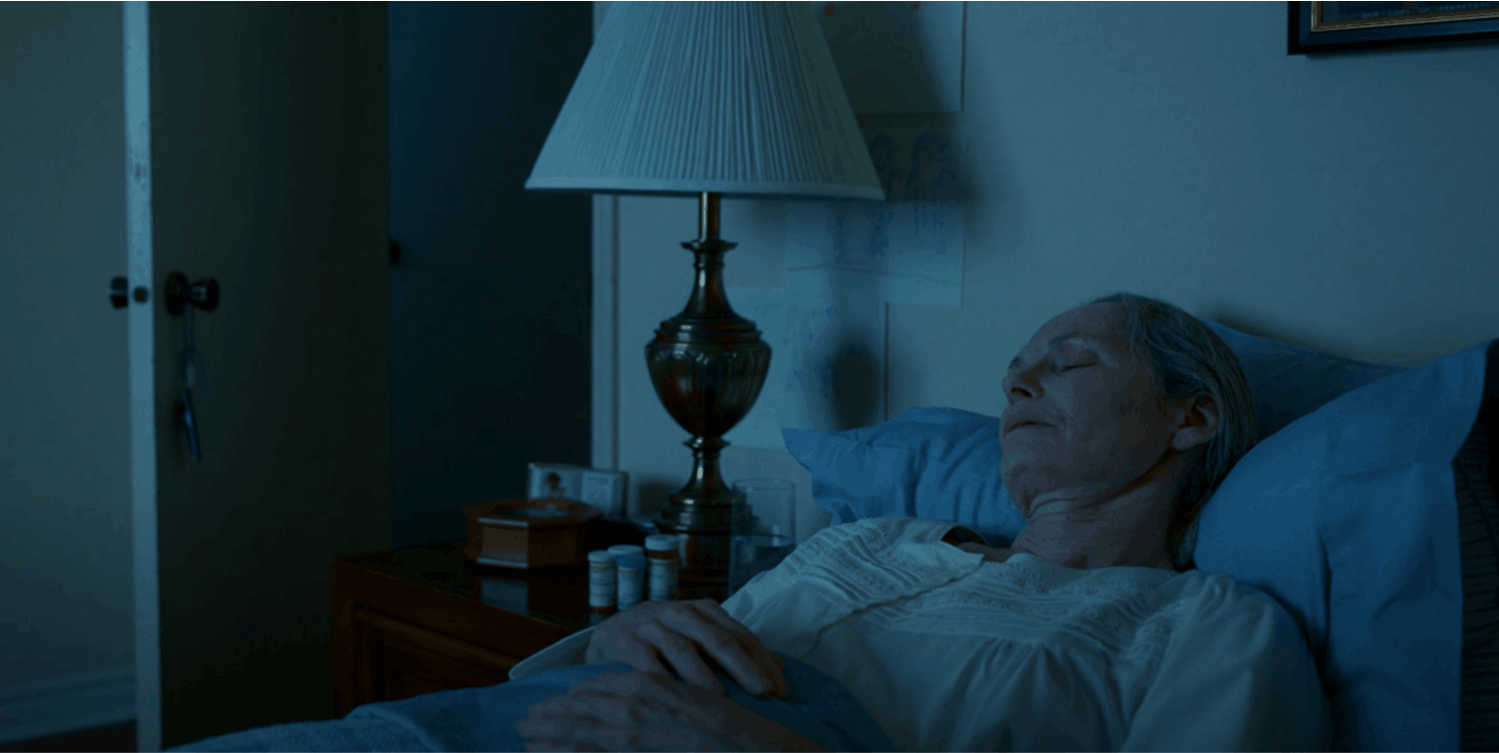
As Tuason took a break from his career and stepped in as his parents’ caretaker, he slowly began to integrate more personalized details from his life, pouring in his rather complicated feelings into a work of fiction. In a conversation with Playback, Tuason opened up about what was going on in his mind at that time, “Feeling like I couldn’t get out of the house, feeling all these emotions that I didn’t want: grief, but also guilt. Because why do I want to leave so badly?” While these are all difficult questions to answer, by incorporating them into ‘Undertone,’ he created a work that can resonate with others who might be on the same boat.
Tuason’s mother died in April 2021, and two years later, his father passed away in October 2023. “I was around so much death,” the writer-director noted, “All I knew was that I wanted to make a movie before I died.” As ‘Undertone’ shifted from being a radio play to a screenplay, Tuason began to conceptualize the project in greater detail, determined to bring the story to life. As fate would have it, the movie was largely filmed in his own family home, adding a more powerful element of realism to the narrative. While the overall concept of a sound-based horror story may have been constructed from scratch, Tuason’s own experiences and creative interests lay the foundation of this work.
The Undertone is an Invented Podcast Brought to Life Practically On-Set
‘The Undertone’ is the name of the fictional paranormal-adjacent podcast that exists in the world of ‘Undertone.’ As the primary narrative vessel, it is in many ways a frame world in and of itself, which makes sense considering that the film was originally conceptualized as a radio play. It’s possible that the transition from radio to film facilitated the development of ‘The Undertone,’ as we see on screen, in alignment with writer-director Ian Tuason’s horror philosophy. Initially, Tuason wanted to add hidden details to his work, citing legendary horror filmmaker Mike Flanagan as an influence. However, Tuason seemingly changed his mind after watching ‘The Babadook,’ another classic of the genre, which notably relies on the audience’s assumptions to craft its horror.
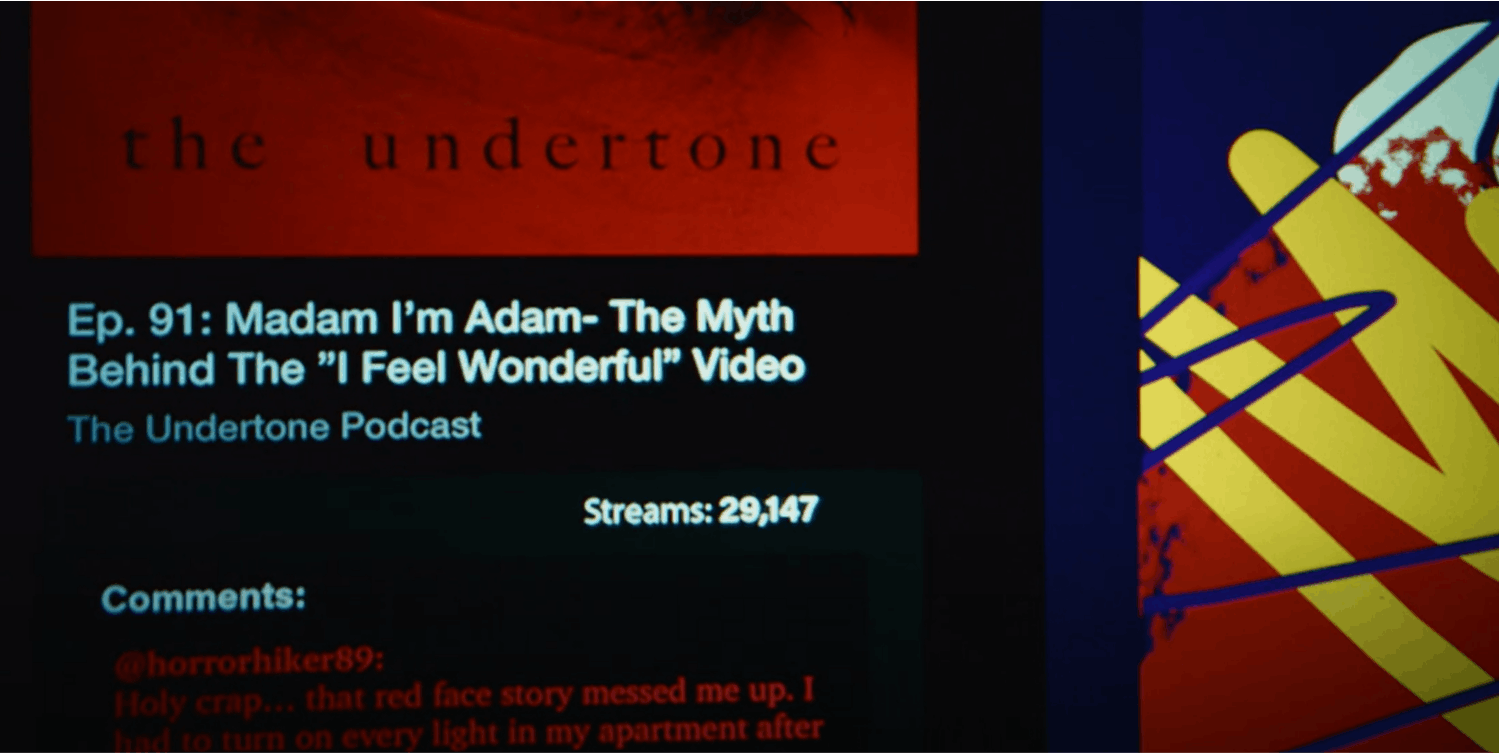
With an auditory medium such as a podcast, Tuason gets to walk a different path than his peers, relying on the underexplored potential of sound as a source of horror. While there are several real-life paranormal-themed podcasts that achieve a similar effect in real life, such as ‘Otherworld,’ ‘Let’s Get Haunted,’ and ‘Last Podcast On The Left,’ it’s unlikely that Tuason based his own creation on any specific real-life antecedent. Instead, it’s more likely that he and his creative team conducted research on how genre podcasts work, and connected that to the film’s sound-centric storytelling. Most of the audio notes featured in the movie were recorded on set with an iPhone, with the audio often being played back in real-time as the podcast sequences were being filmed, all to maximize the realism effect.
Ian Tuason Reimagined the Story of a Demon Recorded in Real-Life Folklore
At the heart of ‘Undertone’ lies the demonic spirit known as Abyzou, who functions brilliantly as an antagonistic force despite not being shown once on-screen. While its existence in-universe is still a subject of debate amongst fans, the entity itself is loosely based on a mythic demon found in real-life European and Mediterranean folklore. Abyzou, also known as Obizu or Obyzouth, has been identified in cultures dating back to antiquity and spanning several civilizations. Its most complete depiction, and the one incorporated into the film, comes from the ‘Testament of Solomon,’ a demonological text dating as far back as the 1st century CE, as per some historians.
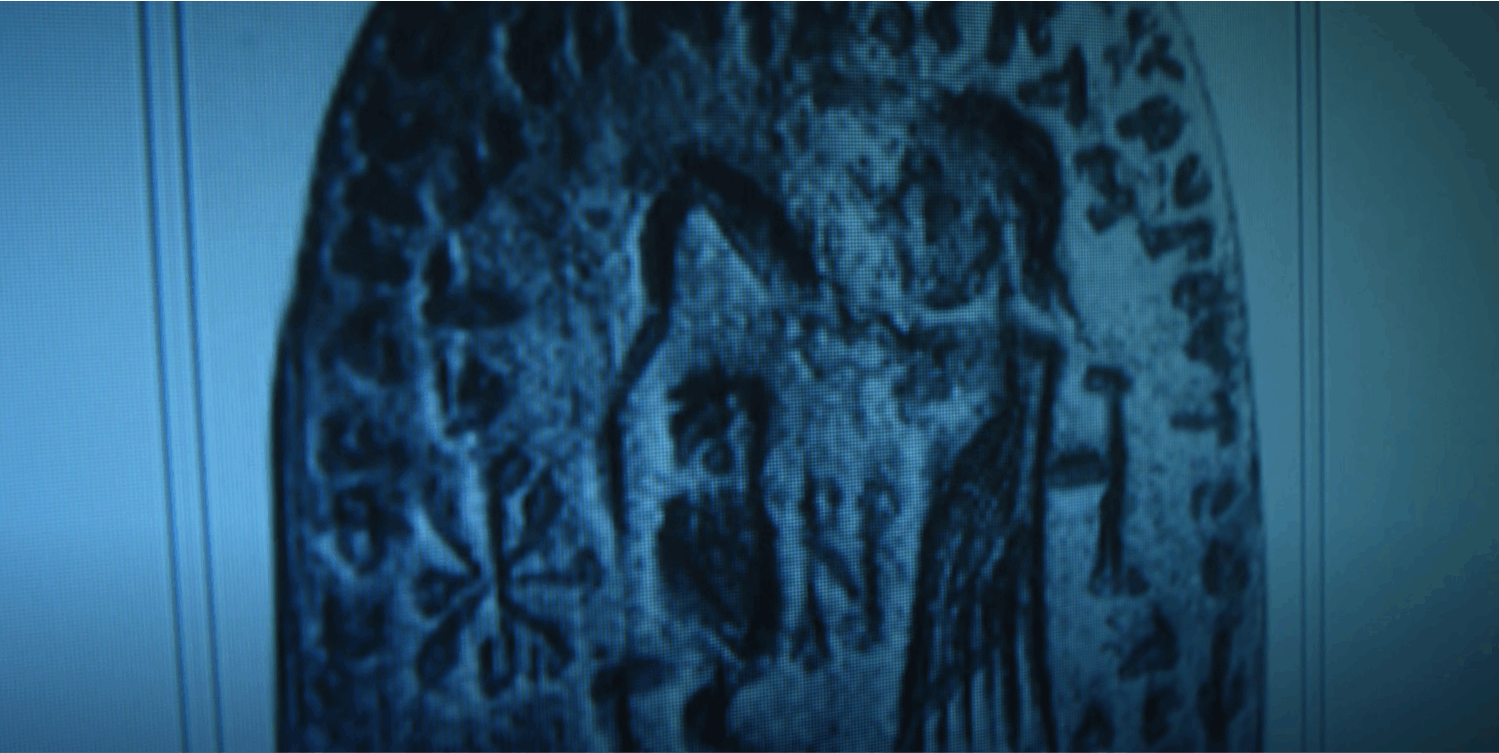
In the ‘Testament of Solomon,’ Abyzou is described as a demon who wanders the world in search of women who are about to give birth, and then attempts to strangle their newborn babies to death. Variations of these myths and legends have been documented across several cultures, be it in the form of inscriptions on Byzantine bronze amulets, or in Coptic Egyptian-era wall paintings, where she is called Alabasandria. Notably, the movie retains many of the historical details surrounding the demon, such as the Byzantine amulet. However, the myth surrounding Abyzou is nonetheless reimagined to a heavy extent, with writer-director Ian Tuason adding a modern twist to fit her into his story.
When writing the movie, Tuason was looking for demons from myths and folklore that are specifically known to target children. This is how he found Abyzou, and the more he researched, the more the pieces of the puzzle fit. While talking to In Review Online, he noted that the ‘Testament of Solomon’ has had an oral tradition of passing, which he found similar to the concept of nursery rhymes, thus connecting to the movie in a brand new fashion. He further stated that the testament is something “that gets passed on from generation to generation until we have this being that exists only in our imagination,” before positing, “since we’re all connected in many ways, in language and culture, who’s to say that this entity doesn’t really exist?” Abyzou’s depiction on screen, a mix of historical fact, myth, and fiction, brings that question to the center stage, adding to the film’s ambiguity-driven horror.
Read More: Undertone Ending Explained: Is Evy Killed by Her Mother?


You must be logged in to post a comment.