
 Naman Shrestha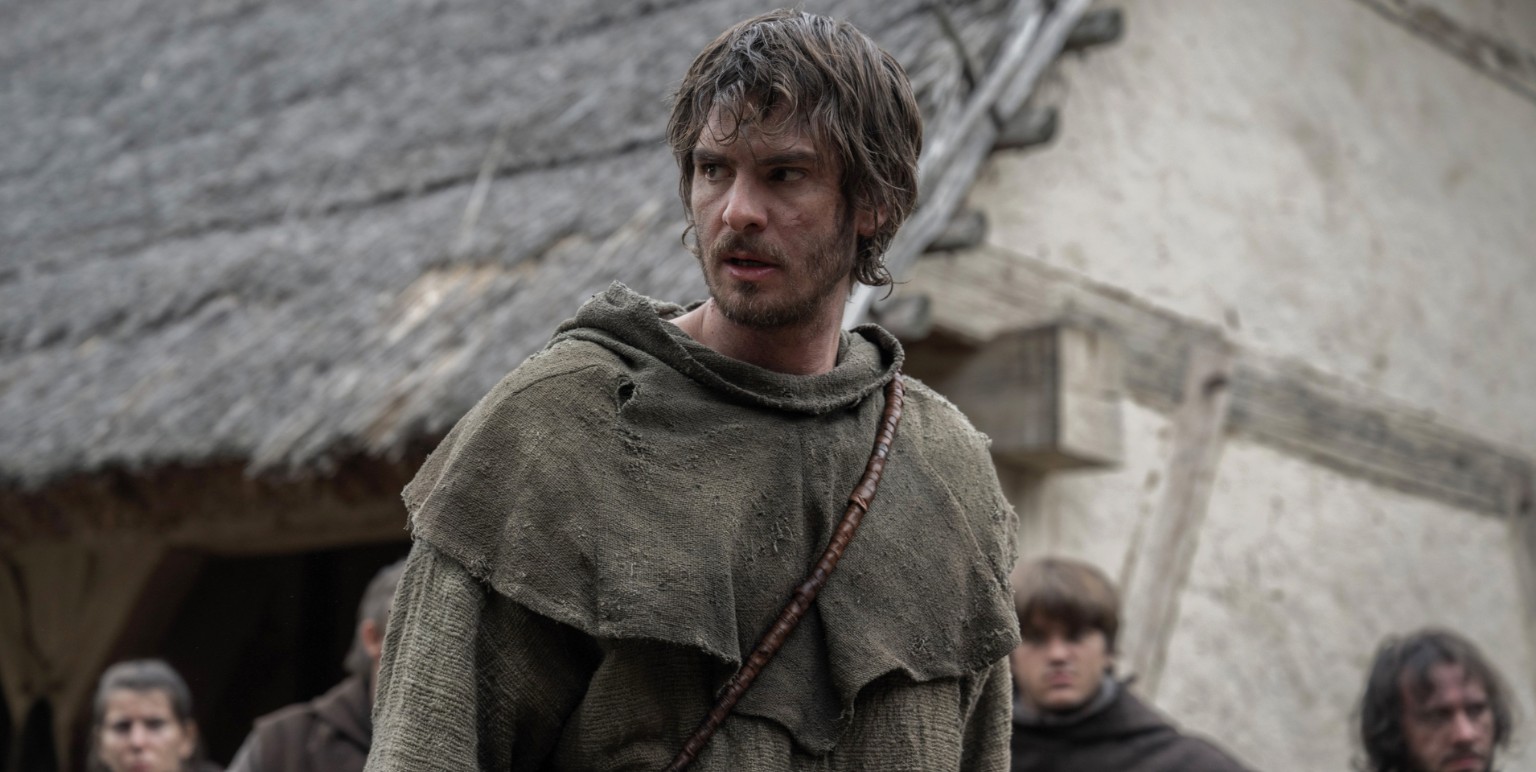
Based on true events, ‘The Uprising’ is a period action drama movie written and directed by Paul Greengrass. Andrew Garfield stars as Robin Hood, a poor farmer living under the rule of King Richard II. Set in the 19th century, the narrative revolves around a plague that claims half of England’s population, after which the King imposes a tax on the nation’s poorest. Consequently, Robin raises his voice against the injustice and forms an army of thousands of commoners, who are also enraged at the decision.
Leading a rebellion against the tyranny, Robin marches on London, ready to face the King in the name of justice. Besides Garfield, the film also features Jamie Bell, Stephen Dillane, Tom Hollander, Cosmo Jarvis, Thomasin McKenzie, and Jonny Lee Miller. The rebellious tale unfolds in 1800s England, with Robin Hood and his army marching on muddy roads and voicing their discontent with King Richard II’s tax imposition.
The Uprising Filming Locations
‘The Uprising’ was filmed in Germany, particularly in Upper Bavaria and Franconia, under the working title ‘The Rage.’ Principal photography for the Andrew Garfield starrer reportedly commenced in September 2025 and continued for about two months before concluding in November of the same year. During the shoot, the makers hired approximately 5,000 extras to bring the epic period film to life.
Upper Bavaria, Germany
Many pivotal sequences for ‘The Uprising’ were lensed in Upper Bavaria, situated in the southern portion of Germany’s landlocked state of Bavaria. To be specific, the production team made the most of the facilities at Penzing Studios, located at Kauferinger Str. 32-34 in the municipality of Penzing, near Munich. Spread across 40,000 square meters, the film studio is home to six different sound stages, make-up rooms, workshop space, production office space, and storage space. Its backlot area resembles a small town, with numerous on-set locations, including a church, a hospital, a monastery, a power plant, and more.
During a conversation with Deadline, Andrew Garfield was asked to share a few words about his experience of the shoot. He stated, “It was immersive. Everything in Paul’s movie, every department, brought that kind of immersion for the actors and for the story. And yeah, it’s incredibly impressive what the costume department did with limited funds and what the set department did. It’s really, really an incredible thing. Honestly, it was wonderful shooting in Germany, in Bavaria. We had a really great time with a great German crew and some people from Budapest as well.” To recreate Medieval London, the makers reportedly built a section of the bridge from scratch and extended it with the help of the visual effects team.
Elaborating on the same, the director Paul Greengrass added on the same interview, “for London Bridge, we built a section of it, actually which was a very cunning set because it had two sides so you could run through one and then you’d come back the other way, and it was as if it was the other. It was what they call a French reverse. I don’t know why — it’s always called in cinema a French reverse. But basically, it’s a clever way you build a set, so you get two sets out of one, it’s a way of getting an expensive set for a very cheap price. But it requires you to move your actors and extras in a certain way and shoot in a certain way to get the benefits of it. And then you set extend so obviously there’s a lot of beautiful visual effects work, which is stunningly authentic, I think, to make this film work.”
Franconia, Germany
The region of Franconia also served as a prominent production location for ‘The Uprising.’ The cast and crew members reportedly set up camp in the city of Nuremberg. They took over multiple churches across the city, including St. Sebaldus Church at Winklerstraße 26 and St. Egidien at Egidienpl. 12, to tape pivotal sequences. In addition, Lichtenau Fortress at Von-Heydeck-Straße 1 in the market town of Lichtenau, as well as the surrounding areas, were turned into film sets. Various key portions were also shot in and around the Franconian Open Air Museum at Eisweiherweg 1 in the town of Bad Windsheim. In the same aforementioned interview, Garfield explained how shooting in nature was a gratifying experience. He also called the extras, background artists, and supporting artists the film’s secret weapon.
He added, “Everywhere you look in frame, you have passionate, true, soulful performances. Whether or not you know who those characters are, you feel them and it’s unconscious in a way. It’s subliminal. It helps provide a deep immersion. And the way that Paul worked with them and directed them and moved them through the lens with the help of Cliff Lanning, our first AD, and Pål (Ulvik Rokseth) our DP and camera operator, it was a masterclass for me. I was very, very observant of how they were managing to create such authenticity while also giving everyone such support and encouragement and love in the action.”
Read More: Where Was By Any Means Filmed? All Shooting Locations

