
 Saagar Kote
Directed by Julia Jackman, ‘100 Nights of Hero’ is set in a medieval-themed town and revolves around the life of Cherry, a woman married to a rich and neglectful man named Jerome. The marriage suffers due to the lack of intimacy between the two. Feeling dissatisfied and pressured to produce an heir to the castle, Cherry’s life is pushed towards uncertainty. When Jerome leaves town, he challenges his friend Manfred in a twisted manner. He offers the castle and everything in it to him if he can seduce Cherry within a hundred nights.
However, Cherry develops a complicated bond with her housemaid Hero, who makes it her goal to prevent Manfred from achieving his task. As Hero narrates stories to Manfred to distract him every night, she must also confront the complexities of her feelings for Cherry. The historical fantasy romance movie explores the themes of love, sexual liberation, feminism, and secrecy, while also featuring suspenseful and haunting visual elements. SPOILERS AHEAD.
100 Nights of Hero Encapsulates the Nuances of Isabel Greenberg’s Novel
‘100 Nights of Hero’ is a layered tale of love and liberation written by the aforementioned director. It captures the essence of Isabel Greenberg’s ‘The One Hundred Nights of Hero,’ the graphic novel it is based on. Both the novel and the film are fictional stories that shed light on grounded human emotions. Essentially, they are tales of liberation set in patriarchal societies. The book is set in the Empire of Migdal Bavel, where Jerome, a rich and cruel man, is married to Cherry. Jerome makes a pact with his friend Manfred that if he succeeds in seducing his wife within one hundred nights, he will give him his castle and Cherry. But Cherry is secretly in love with her maid, Hero. The two characters devise a strategy to distract Manfred.
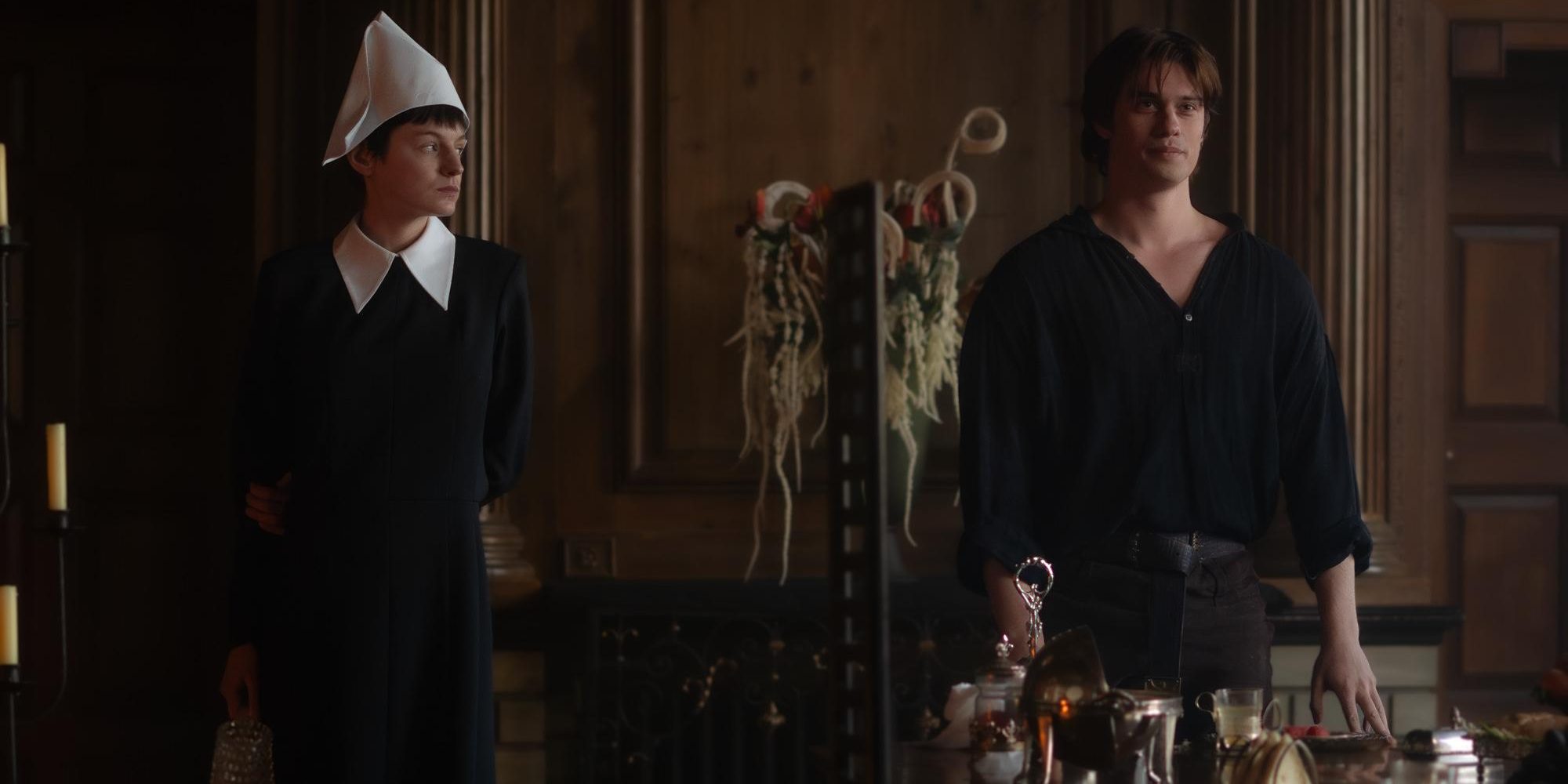
Hero tries to keep Manfred distracted by captivating him with a new story every night for a hundred nights. The essential plot elements of the novel and the movie are strikingly similar. The film is a faithful adaptation that adds its own visual flavor to the story that originated in the book. Although the two works are fictional, they raise important questions about female sexual liberation, queer identity, and the dominance of patriarchal structures. The Julia Jackman directorial chronicles the tumultuous journey undertaken by Hero and Cherry as they fight not only against a biased society but also against their insecurities. The tough journey undertaken by the two characters in pursuit of freedom is at the heart of both stories. The novel is partly inspired by the compilation of several folktales, called ‘One Thousand and One Nights,’ which is known in English as ‘The Arabian Nights.’
Isabel employs the style of Arabic tales to narrate a complex story of two individuals caught in a social trap. In an interview with BFI, the director, Julia Jackman, opined that she read Isabel’s graphic novel shortly after it was published. She added that she kept thinking about the novel for years and finally came up with the draft for the movie. The filmmaker stated, “Isabel’s graphic novel is so epic, but so intimate, and that’s what made me think that even on our small budget we might have a shot.” Ultimately, while the film is an imaginary tale based on a fictional book, it reflects the humanity of Hero and Cherry.
100 Nights of Hero is a Grounded Story of Queer Love
‘100 Nights of Hero’ at its core explores a heartwarming story of love between Hero and Cherry. The setting also adds to the depth of the story, as the two characters secretly wage their own battle against the social limitations. Julia Jackson, talking about the queer themes of the film, said, “I love exploring queer intimacy and love. Everything has become about what genitals people have and what bathrooms they can use, who people want to have sex with and what they may look like. And for me, the sexiness of queerness and of a queer love story is that it’s all up for grabs – there’s no fixed role, nothing is taken for granted.”

The filmmaker added that the character of Hero in the film is nonbinary and has a tumultuous soul. The emotional core of the film is the bonding between Cherry and Hero, where the former feels a sense of calm around the latter. Moreover, a sense of understanding fuels the intimacy between them. Talking to Gayety, the filmmaker expressed that she doesn’t think of queer stories as niche and that she would like to see a variety of them. All in all, the movie is a nuanced tale that reflects fundamental social themes in a layered manner, while also featuring a haunting visual style.
Read More: Is Regretting You Based on a True Story?


You must be logged in to post a comment.